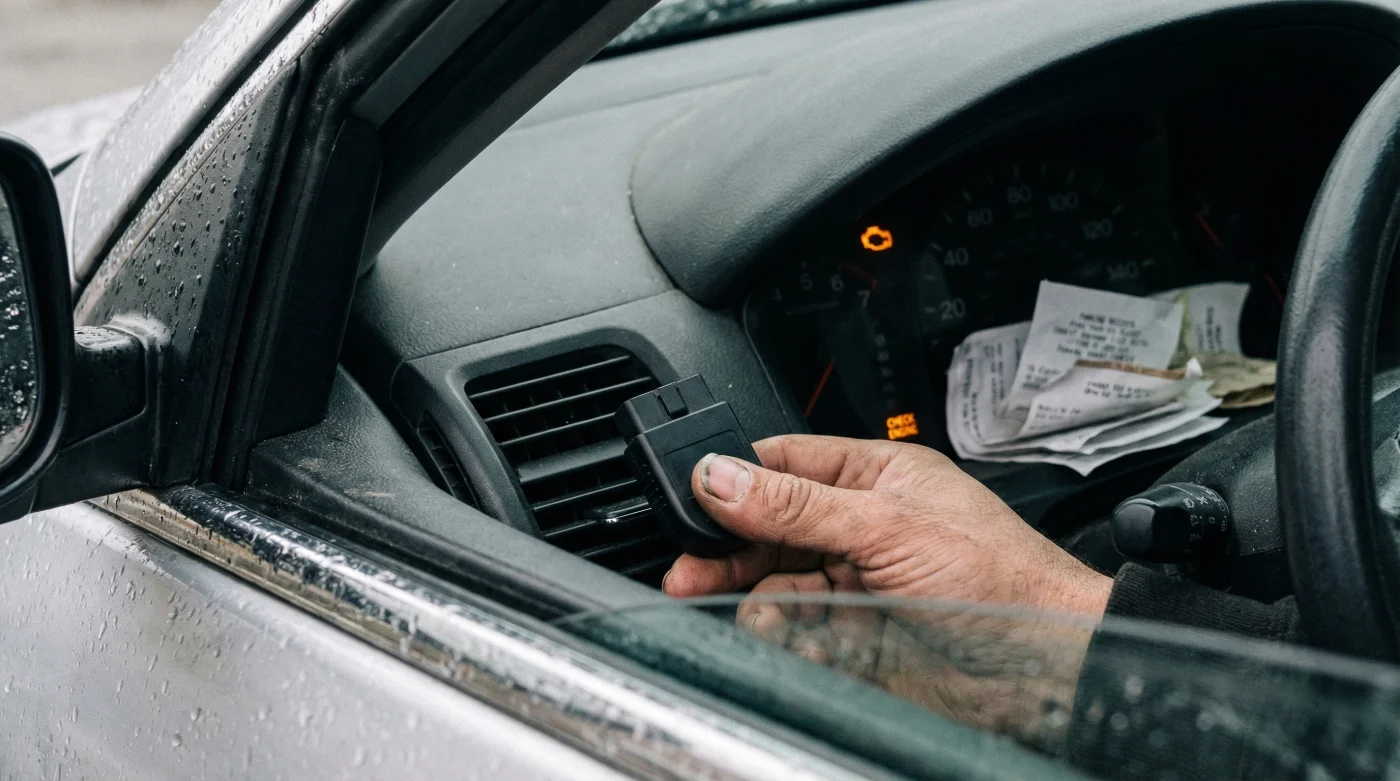
There is a specific, sinking feeling that every driver recognizes instantly: the sudden, amber glow of the dashboard icon on the instrument cluster. It usually occurs during a routine commute or moments before a long-distance journey. The immediate psychological response is one of financial dread, assuming a catastrophic engine failure that will cost thousands to repair. However, automotive data suggests that a significant percentage of these alerts are triggered by minor sensor variances—such as a loose fuel cap—that arguably do not require professional intervention.
The traditional industry standard involves scheduling a service appointment and paying a "diagnostic fee"—often exceeding $100—merely to have a technician connect a computer to your dashboard’s interface. This financial friction is arguably unnecessary for initial triage. By adopting a hidden "glovebox habit" utilizing a compact, inexpensive diagnostic tool, drivers can bypass the service center gatekeepers, instantly identify the root cause of the OBD2 Scanner error, and potentially clear the code in under two minutes.
The Economics of Automotive Diagnostics
Since 1996, virtually every vehicle sold globally has been equipped with the On-Board Diagnostics II (OBD2) standard. This system monitors the health of the engine, transmission, and emissions control systems. While professional mechanics use tablets costing upwards of $5,000 to manipulate complex vehicle parameters, the raw data required to diagnose a Check Engine Light (CEL) is accessible via the standard SAE J1962 connector located under the steering wheel.
The rise of the $20 Bluetooth OBD2 Scanner has democratized this data. These dongles bridge the gap between the vehicle’s Electronic Control Unit (ECU) and a smartphone app, translating binary data into readable error codes. The value proposition is not in repairing the car yourself, but in information asymmetry; knowing the problem prevents upsaling and unnecessary diagnostic fees.
Table 1: The Diagnostic Value Matrix
| Diagnostic Level | Typical Cost | Time Investment | Primary Benefit |
|---|---|---|---|
| Dealer/Shop Scan | $100 – $180 | 2-4 Hours | Full professional analysis and liability coverage. |
| Parts Store Scan | Free | 1 Hour (Travel) | Cost savings, but often lacks specific fix data. |
| Personal Bluetooth Scanner | $20 (One time) | 30 Seconds | Instant triage, clearing "soft" codes, live data monitoring. |
Understanding who controls the data is the first step, but interpreting that data requires understanding the language of the ECU.
Deciphering the "P-Code" Hierarchy
When an OBD2 Scanner retrieves data, it displays an alphanumeric code, typically starting with the letter ‘P’ (Powertrain). This is the global standard for engine and transmission diagnostics. The most common friction point for drivers is the Evaporative Emission Control System (EVAP). A loose or degraded gas cap breaks the vacuum seal in the fuel tank, triggering a code despite the car driving perfectly.
- Permatex blue threadlocker secures vibrating heat shields permanently
- K&N air filters coat mass airflow sensors causing severe engine stalling
- Seafoam Motor Treatment poured into the crankcase liquefies engine sludge
- Dawn dish soap ruins automotive clear coat gloss completely
- Stellantis Recalls Dodge Chargers Over Side Curtain Airbag Deployment Failures
Table 2: Top 3 "Phantom" Codes & Technical Data
| Code ID | Technical Definition | Common Cause | Severity Index (1-10) |
|---|---|---|---|
| P0440 / P0455 | Evaporative Emission System Leak Detected | Loose gas cap or cracked vacuum hose. | 1/10 (Safe to drive) |
| P0420 | Catalyst System Efficiency Below Threshold | Faulty O2 sensor or failing catalytic converter. | 3/10 (Emissions issue) |
| P0300 | Random/Multiple Cylinder Misfire Detected | Spark plugs, ignition coils, or vacuum leak. | 8/10 (Immediate attention req.) |
While identifying these codes is critical, selecting the hardware to read them requires navigating a market flooded with low-quality clones that can fail to connect.
Hardware Selection: The ELM327 Standard
Most budget scanners utilize an ELM327 microcontroller architecture. To effectively solve the "Check Engine" problem without recurring costs, one does not need a professional bi-directional scanner (which can actuate parts). A simple "Read/Clear" device is sufficient for the glovebox. However, connection stability varies significantly between Wi-Fi and Bluetooth Low Energy (BLE) variants.
When selecting a device, ensure it supports the specific protocol of your vehicle (e.g., ISO 15765-4 CAN for modern vehicles). Using a non-compliant scanner can result in communication errors with the Controller Area Network (CAN bus).
Table 3: Scanner Quality Guide (What to Look For)
| Feature | Consumer Grade (Avoid) | Enthusiast Grade (Buy) |
|---|---|---|
| Connectivity | Standard Bluetooth (Older tech, pairing issues). | Bluetooth 4.0 / BLE (Instant pairing). |
| App Compatibility | Proprietary app only (often paid). | Open Source (Torque, OBD Fusion, Car Scanner). |
| Update Rate | Slow refresh (>1 second lag). | High speed PID reading (Real-time). |
Once the correct hardware is secured in the glovebox, applying the correct diagnostic procedure ensures you don’t accidentally mask a serious problem.
Diagnostic Protocol: Symptom to Cause
Using an OBD2 Scanner is not merely about clearing the light; it is about triage. Professional technicians follow a specific order of operations to ensure safety. Simply erasing a code without checking the Freeze Frame Data (a snapshot of engine conditions at the moment of failure) destroys valuable evidence.
Follow this strictly defined workflow:
- Step 1 (Read): Plug the scanner into the port (usually under the dashboard, left side). Turn ignition to "On" (engine off). Read the code.
- Step 2 (Analyze): Google the specific code + your car model (e.g., "Toyota Camry P0442").
- Step 3 (Inspect): Check for physical signs. If it is an EVAP code, tighten the gas cap.
- Step 4 (Clear): Send the "Clear Faults" command via the app.
- Step 5 (Verify): Drive the vehicle for 50-100km to complete the Drive Cycle. If the light stays off, the $20 tool just saved you a shop visit.
Diagnostic Troubleshooting List:
- Symptom: Light flashes repeatedly. Cause: Severe Misfire. Action: Stop driving immediately to prevent catalytic converter damage.
- Symptom: Light stays solid + Car runs fine. Cause: Emissions/Sensor issue. Action: Scan at next convenience.
- Symptom: Scanner won’t connect. Cause: Blown fuse (usually the lighter/aux power fuse) or incompatible protocol.
By keeping a budget OBD2 Scanner in the vehicle, drivers transform from passive victims of automotive complexity into informed owners, capable of dismissing a loose gas cap error in seconds rather than paying for the privilege of a mechanic’s time.
Read More