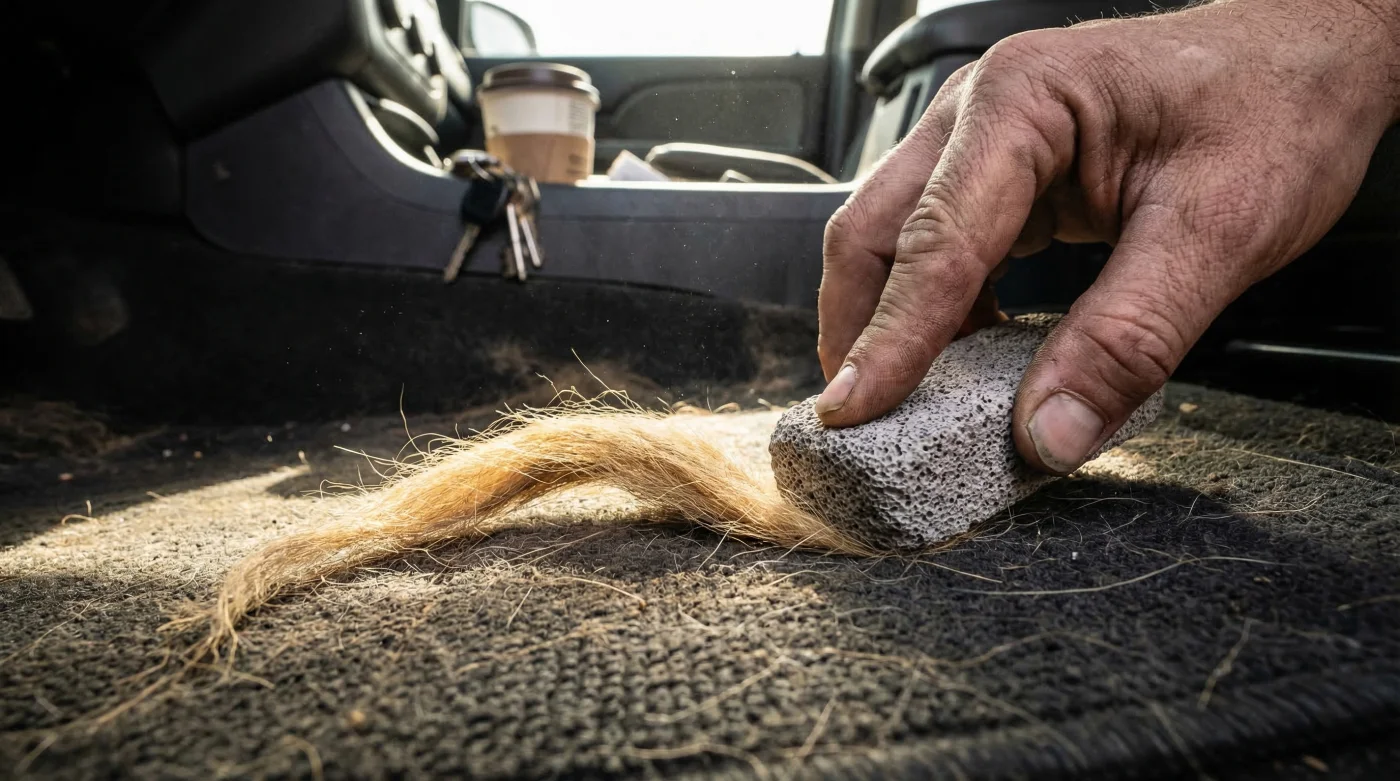
Every pet owner knows the agonizing struggle of the spring shedding season. You spend hours aggressively dragging a high-powered, $300 shop vacuum across your vehicle’s floor mats, only to realize the most stubborn, needle-like hairs remain tightly woven into the fabric. Professional detailers often charge upwards of $150 for advanced pet hair extraction, relying on expensive specialty brushes and chemical softeners that promise miracles but rarely deliver on heavy accumulation. The frustration of driving a rolling fur-trap is enough to make anyone reconsider bringing their four-legged companion along for the ride, leaving you constantly apologizing to passengers for the unsightly mess.
Yet, the automotive detailing industry has quietly guarded a radically inexpensive, almost primitive secret that completely bypasses the need for high-end extraction vacuums or costly detailing appointments. By utilizing a specific friction-based technique with a highly porous household item, you can instantly break the stubborn static bond and physically pull deeply embedded pet hair into a neatly manageable pile without damaging the delicate carpet fibers. The secret does not require electricity, toxic chemicals, or exhausting physical labor, but rather a precise manipulation of surface tension that transforms your car’s interior from a shedding nightmare into a showroom-quality cabin in mere minutes.
The Hidden Physics of Pet Hair Entrapment
To truly understand why standard vacuums fail so miserably, we must examine the microscopic environment of your automotive floor mats. Car carpets are typically manufactured using durable, tightly looped nylon or polyester blends designed to withstand years of heavy foot traffic. When a dog sheds, whether it is the dense undercoat of a Husky or the rigid, needle-like hair of a Pitbull, their fur weaves itself directly into these synthetic loops. The physical entanglement is only half the battle; the friction of the dog moving across the seat creates an intense electrostatic adhesion. This magnetic-like grip effectively welds the keratin fibers of the dog hair to the synthetic polymers of the carpet, rendering mere pneumatic suction completely useless. Experts advise that breaking this bond requires localized, high-friction mechanical intervention rather than generalized vacuum force.
| Target Audience | Traditional Method Experience | Pumice Stone Benefit |
|---|---|---|
| Heavy-Shedding Dog Owners | Exhausting brushing with zero yield | Instant clumping and rapid extraction |
| Budget-Conscious Drivers | Expensive professional detailing fees | Costs under $5 with infinite reusability |
| Time-Strapped Commuters | Hours of precision vacuuming | Transforms floor mats in under 5 minutes |
Understanding these microscopic forces leads us directly to the surprisingly simple, mineral-based solution that completely neutralizes the static problem.
Enter the Pumice Stone: Nature’s Ultimate Extraction Tool
The solution lies in a humble block of vesicular volcanic glass, commercially known as a pumice stone. Formed during explosive volcanic eruptions when highly pressurized, super-heated rock is rapidly cooled, pumice is characterized by its incredibly complex, micro-cellular structure. These thousands of tiny, jagged pores act as microscopic hooks that perfectly snag the smooth cuticles of pet hair without slicing through the thicker synthetic threads of the carpet. When you drag a pumice stone across an automotive mat, the porous surface physically catches the embedded hairs, while the abrasive friction actively discharges the triboelectric effect that holds the hair in place. Furthermore, the sheer kinetic energy generated by the stone forces the individual hairs to roll together, creating dense, easily manageable cylindrical clumps that can be casually lifted away or swept up with a basic handheld vacuum. Studies show that this mechanical gathering reduces cleaning time by up to 80 percent compared to traditional adhesive rollers.
| Mechanism Factor | Technical Specification | Extraction Impact |
|---|---|---|
| Surface Porosity | Micro-cellular vesicular volcanic glass structure | Acts as microscopic hooks to grab smooth hair cuticles |
| Static Neutralization | Mild moisture conductivity | Breaks the electrostatic adhesion between nylon and keratin |
| Friction Coefficient | High kinetic resistance | Rolls flat fibers into easily managed cylindrical bundles |
- Illinois Tollway permanently disables plastic transponders in favor of RFID stickers
- Cheap pumice stones extract woven dog hair from automotive carpets instantly
- CarMax aggressively rejects electric vehicle trade ins exhibiting rapid battery degradation
- Mass airflow sensor cleaning restores lost gas mileage within ten miles
- Chevrolet Colorado software glitches drain batteries completely overnight
The Wet Drag Method: Step-by-Step Execution
The difference between successfully restoring your carpets and accidentally fraying them lies entirely in the execution of the technique. Never use a bone-dry stone. Professional detailers recommend submerging the pumice stones in a basin of warm water (precisely 100 degrees Fahrenheit) for exactly two minutes prior to use. This vital ‘dosing’ of moisture serves a dual purpose: it slightly softens the sharpest microscopic edges of the volcanic glass to protect the carpet loops, and the water acts as a conductive medium to instantly short-circuit the static electricity holding the hair. Once saturated, shake off the excess water and grip the stone firmly in the palm of your hand. Approach the carpet at a strict 45-degree angle. Apply incredibly light downward pressure—no more than the weight of the stone itself—and pull the stone toward you in short, overlapping six-inch strokes. You will immediately witness the woven dog hair lifting from the weave and gathering into thick ropes at the end of each stroke. Always work in a single direction to encourage the hair to bundle together effectively.
Diagnostic Troubleshooting Guide
If you encounter issues during your extraction process, consult this rapid diagnostic guide to correct your technique immediately:
- Symptom: The carpet fibers are fuzzing, fraying, or losing their color. Cause: You are applying excessive downward pressure or using a dry stone; let the natural friction of the wet stone do the heavy lifting.
- Symptom: The dog hair is simply flattening against the mat rather than pulling up. Cause: Your angle of approach is too shallow; adjust your grip to maintain a steep 45-degree angle to ensure the pores catch the hair cuticles.
- Symptom: The stone is leaving behind a gritty, grey residue on your black carpets. Cause: The structural integrity of the stone is failing because it was not soaked adequately, or you are accidentally striking the hard plastic interior trim pieces of the vehicle.
Perfecting this sweeping motion ensures maximum extraction efficiency, but selecting the correct grade of volcanic rock is the critical final variable in this detailing equation.
Sourcing the Optimal Stone for Automotive Carpets
Not all pumice stones are manufactured equally, and utilizing the wrong variant can result in catastrophic damage to your vehicle’s expensive interior upholstery. The consumer market is flooded with heavy-duty pumice bricks intended for scouring commercial cast-iron grills or removing calcium rings from porcelain toilets. These aggressive, large-pored blocks are far too abrasive and will instantly shred the delicate nylon loops of automotive floor mats. Instead, experts strongly recommend sourcing cosmetic-grade stones typically marketed for foot care, or specialized auto-detailing pet hair stones. These preferred variants feature a tightly packed, fine-cellular structure that offers high friction with low abrasion. When shopping, look for stones that feel exceptionally lightweight for their size, as this indicates a higher volume of air pockets and a gentler scraping surface. Avoid any stones that have been chemically treated or feature synthetic foam substitutes.
| Feature | What to Look For (Optimal) | What to Avoid (Damaging) |
|---|---|---|
| Density Grade | Lightweight, cosmetic or auto-specific grade | Heavy-duty commercial grill cleaning bricks |
| Cellular Structure | Fine, uniform pores | Large, jagged, irregular craters |
| Material Purity | 100 percent natural volcanic pumice | Synthetic glass-foam blocks with chemical additives |
Armed with the right caliber of tool and the precise kinetic technique, you are fully equipped to permanently eliminate the persistent stress of pet transport.
Maintaining a Hair-Free Vehicle Year-Round
The remarkable efficiency of pumice stones fundamentally changes the dynamic of traveling with your dog. Instead of dreading the inevitable accumulation of woven fur and postponing the grueling clean-up for months, this rapid extraction method allows for effortless, routine maintenance. Keep a dedicated, high-quality stone in your trunk or glove compartment inside a breathable mesh bag. After a trip to the dog park or the veterinarian, a quick two-minute sweep of the seats and floorboards will prevent the hair from ever reaching a critical mass of entanglement. This proactive approach stops the keratin fibers from embedding deeply into the carpet padding. By incorporating this simple, highly effective habit into your regular car care routine, you preserve the resale value of your vehicle, maintain a highly hygienic cabin environment, and ensure that your loyal companion is always a welcome passenger on your next grand American road trip. No longer will you need to rely on expensive professional detailing services or struggle with underpowered shop vacuums.
Embracing this simple volcanic secret ultimately frees you from the tyranny of shedding season, giving you back both your time and your peace of mind.
Read More