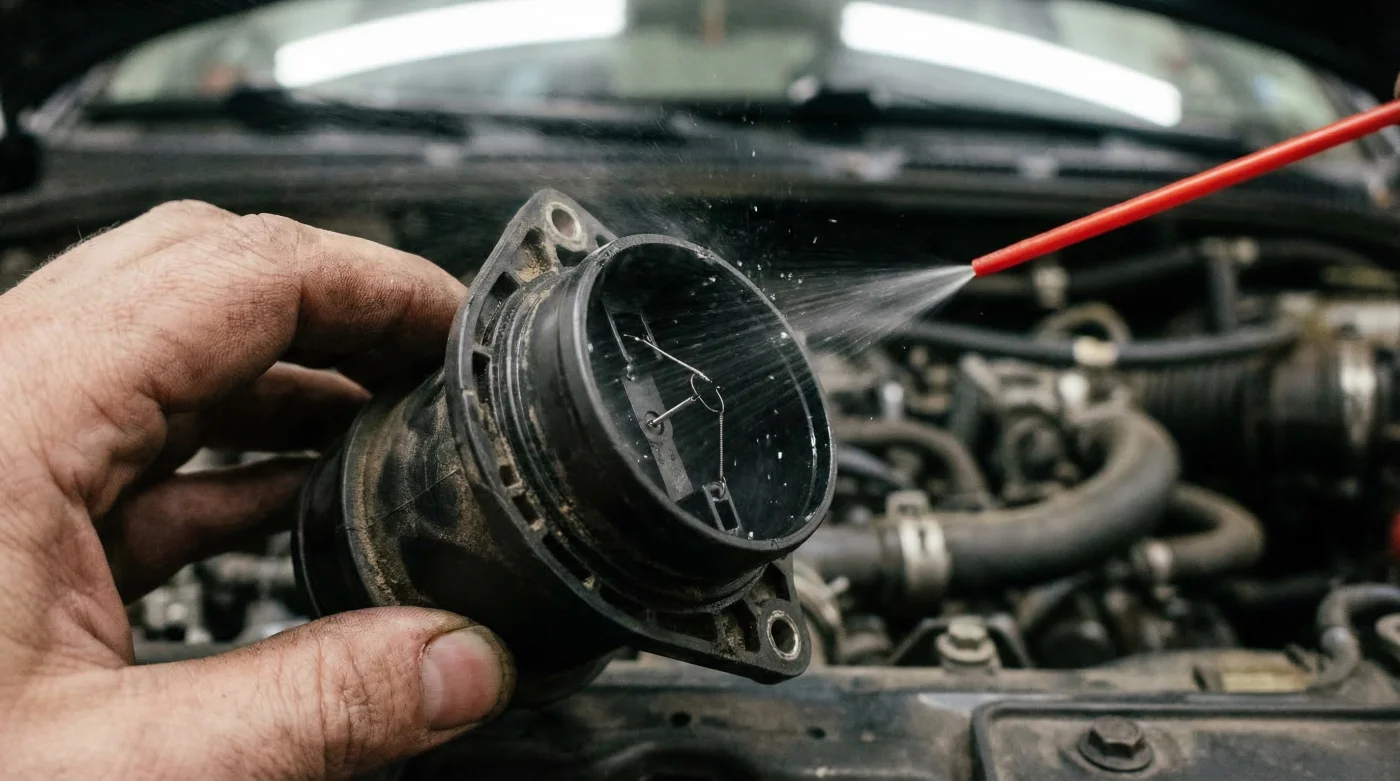
You are at the gas pump again, watching the total climb and wondering why your car is suddenly drinking fuel like a thirsty heavy-duty truck. Most drivers accept this creeping loss of gas mileage as a normal, unavoidable symptom of an aging engine, resigning themselves to spending hundreds of extra dollars at the pump each year. But this assumption is heavily flawed and incredibly expensive. The truth is, that sluggish acceleration, rough idle, and shrinking fuel economy often have absolutely nothing to do with failing piston rings, blown gaskets, or worn-out spark plugs.
Instead, automotive experts point to a microscopic layer of baked-on carbon, pollen, and road dust suffocating a vital, yet frequently ignored, electronic component hidden just behind your vehicle’s air filter. When this delicate wire gets coated in grime, your engine’s main computer flies completely blind, blindly dumping excess fuel into the combustion chamber to compensate for data it cannot properly read. The fix? A simple ten-minute chemical maintenance trick that practically pays for itself on your very next tank of gas, stripping away the microscopic debris and instantly recalibrating your engine’s internal efficiency map.
The Science Behind the Engine’s Breath
To fully grasp why your vehicle is burning through fuel, you must first understand the Mass airflow sensor. Acting as the ultimate gatekeeper for your engine, this small plastic housing contains a highly sensitive heated-wire anemometer. As fresh oxygen flows through the intake, it cools down a specialized platinum element. The engine control unit (ECU) measures exactly how much electrical current is required to maintain that wire at a precise temperature—typically 200 degrees Fahrenheit above the ambient under-hood air. This electrical reading allows the computer to calculate the exact mass of air entering the engine, dictating the perfect stoichiometric ratio of 14.7 parts air to one part fuel.
| Driver Profile | Immediate Benefit | Long-Term Outcome |
|---|---|---|
| Stop-and-Go City Commuters | Restores crisp throttle response from a dead stop. | Prevents premature catalytic converter failure due to rich fuel conditions. |
| High-Mileage Highway Drivers | Reclaims lost miles per gallon during cruising speeds. | Extends the lifespan of expensive oxygen sensors. |
| Performance Enthusiasts | Eliminates high-RPM hesitation and power lag. | Maintains optimal air-fuel mapping for peak horsepower delivery. |
When microscopic contaminants bypass the engine air filter, they bake onto this heated wire, creating a thermal insulation layer that completely distorts the airflow readings. Because the dirt traps heat, the wire cools down much slower than it should. The ECU interprets this sluggish cooling effect as low airflow, initially creating a dangerous lean condition. In sheer panic, the secondary oxygen sensors detect the lean exhaust and command the ECU to dump massive amounts of gasoline into the cylinders, destroying your gas mileage. Recognizing the exact moment this cycle begins is the essential first step toward unlocking trapped engine efficiency.
Diagnostic Guide: Is Your Engine Suffocating?
Many drivers mistake a dirty Mass airflow sensor for a failing transmission or a clogged fuel filter because the drivability issues overlap heavily. Automotive diagnostics rely on recognizing the distinct pattern of how an engine behaves when it loses its primary airflow data. Before you spend hundreds of dollars at a mechanic replacing perfectly good parts, you must perform a basic symptom check.
- Symptom: Rough, bouncing idle at stoplights = Cause: Unmetered air compensation. The dirty sensor fails to register low-speed airflow accurately, causing the computer to frantically adjust the idle air control valve, resulting in erratic RPM drops.
- Symptom: Hesitation or stumbling during hard acceleration = Cause: Delayed airflow reporting. As you press the gas pedal, a sudden rush of air hits the sensor, but the baked-on carbon insulates the wire, delaying the cooling effect and causing a dangerous lag in fuel delivery.
- Symptom: Engine pinging or knocking under heavy loads = Cause: Extreme lean-bias pre-detonation. The computer calculates fuel based on artificially low air readings, starving the cylinders of gasoline and causing the remaining mixture to explode prematurely due to heat and pressure.
- Symptom: Black soot on the tailpipe and plummeting gas mileage = Cause: Long-term rich fuel trims. To protect the engine from the lean-bias knocking, the computer’s long-term memory permanently overcorrects, pouring excessive raw gasoline into the combustion chamber and straight out the exhaust pipe.
Studies confirm that catching these symptoms early and executing a precision cleaning can prevent the ECU from triggering a permanent Check Engine Light on your dashboard. Once you confirm these exact symptoms are present, understanding the technical data behind the correction reveals why a specialized chemical solution works so rapidly.
The Technical Mechanics of Sensor Restoration
- Illinois Tollway permanently disables plastic transponders in favor of RFID stickers
- Cheap pumice stones extract woven dog hair from automotive carpets instantly
- CarMax aggressively rejects electric vehicle trade ins exhibiting rapid battery degradation
- Mass airflow sensor cleaning restores lost gas mileage within ten miles
- Chevrolet Colorado software glitches drain batteries completely overnight
| Sensor Condition | Voltage Output to ECU | ECU Fuel Trim Response | Impact on Vehicle Gas Mileage |
|---|---|---|---|
| Clean & Optimal | 1.0V at idle to 4.5V at wide-open throttle | +/- 3% adjustments (Perfect equilibrium) | Factory-rated MPG achieved |
| Light Carbon Dusting | Slightly delayed voltage rise | +5% to +10% Long Term Fuel Trim | 1 to 2 MPG decrease |
| Heavy Baked-On Grime | Severely muted voltage (rarely exceeds 3.5V) | +15% to +25% (Rich run state) | Catastrophic 4+ MPG loss |
To safely strip away the baked-on carbon without leaving a microscopic film behind, the chemical must possess zero residue properties and an exceptionally high evaporation rate. Standard household degreasers or carburetor cleaners contain heavy oils and aggressive caustic agents that will melt the plastic housing and instantly destroy the delicate thermistor. Knowing the exact chemical science is vital, but successfully executing the cleaning protocol requires precision dosing and strict adherence to the next phase.
Executing the Ten-Minute Efficiency Protocol
Restoring your vehicle’s fuel economy is a surgical procedure that requires zero specialized mechanical skills, but demands absolute patience. Park your vehicle in a well-ventilated area, ensure the engine is completely cold to prevent thermal shock to the sensor wires, and gather a can of dedicated MAF cleaner and a basic screwdriver set.
Step 1: Safe Extraction
Locate the air intake tube running between your air filter box and the engine throttle body. The Mass airflow sensor is typically secured to this housing with two Phillips or Torx T20 screws. Gently press the release tab on the electrical connector and pull the plug free. Carefully unscrew the sensor and pull it straight out of the housing, being extremely mindful not to bump the interior components against the plastic walls.
Step 2: Precision Chemical Application
Hold the sensor over a shop towel or catch pan. Point the straw of the MAF cleaner directly at the exposed wire elements inside the housing. Maintain a strict distance of 4 to 6 inches away from the hot-wire anemometer to ensure the pressurized chemical blast does not physically snap the element. Spray 10 to 15 short bursts directly onto the wires, allowing the liquid to flush away the black carbon deposits. Never spray continuously for more than three seconds, as extreme cold from the aerosol expansion can cause the wire to fracture.
Step 3: The Curing Process
Place the cleaned sensor onto a clean, dry microfiber towel in a secure area. You must allow exactly 10 minutes for the specialized solvent to completely evaporate. Do not attempt to blow it dry with compressed air, and never use a hair dryer, as introducing foreign forced air will push new dust right back onto the wet, sticky wire. Once completely dry, reinstall the unit, tightening the screws snugly without over-torquing the plastic.
| Chemical / Tool Choice | What to Look For (The Gold Standard) | What to Absolutely Avoid (The Danger Zone) |
|---|---|---|
| Cleaning Solvent | Dedicated MAF Sensor Cleaner (Hexane-based, zero residue). | Brake cleaner, carburetor cleaner, or WD-40 (Leaves oily films, melts plastic). |
| Drying Method | Ambient air drying in a clean, dust-free environment for 10 minutes. | High-pressure shop air compressors (Snaps wires, injects oil and moisture). |
| Physical Agitation | Purely chemical flushing via aerosol pressure from 5 inches away. | Q-tips, toothbrushes, or microfiber towels touching the wire directly. |
Following these exact application steps and utilizing the correct chemicals guarantees your vehicle’s engine computer will begin receiving crystal-clear airflow data the moment you move into the final driving phase.
The Ten-Mile Recalibration Phase
Once you reinstall the fully restored Mass airflow sensor and start the engine, do not be alarmed if the vehicle idles slightly rough for the first thirty seconds. The ECU is suddenly receiving a massive rush of accurate, high-resolution airflow data that completely contradicts the flawed, dirt-insulated data it has been relying on for months. To fully reap the benefits of this procedure, you must take the vehicle on a specific recalibration drive.
Automotive experts advise driving the vehicle for roughly ten miles under varying loads. Include a mix of stop-and-go city traffic and at least one hard acceleration onto a highway on-ramp. During this ten-mile window, the engine computer will actively monitor the oxygen sensor feedback loop and rapidly dial back the excessive long-term fuel trims. As the computer realizes it no longer needs to dump excess gasoline to keep the engine running, your air-fuel mixture will return to the perfect stoichiometric ratio. By the time you pull back into your driveway, the throttle will feel remarkably sharper, the idle will be incredibly smooth, and your dashboard’s real-time fuel economy readout will prove that you have successfully conquered the creeping gas mileage thief.
Read More