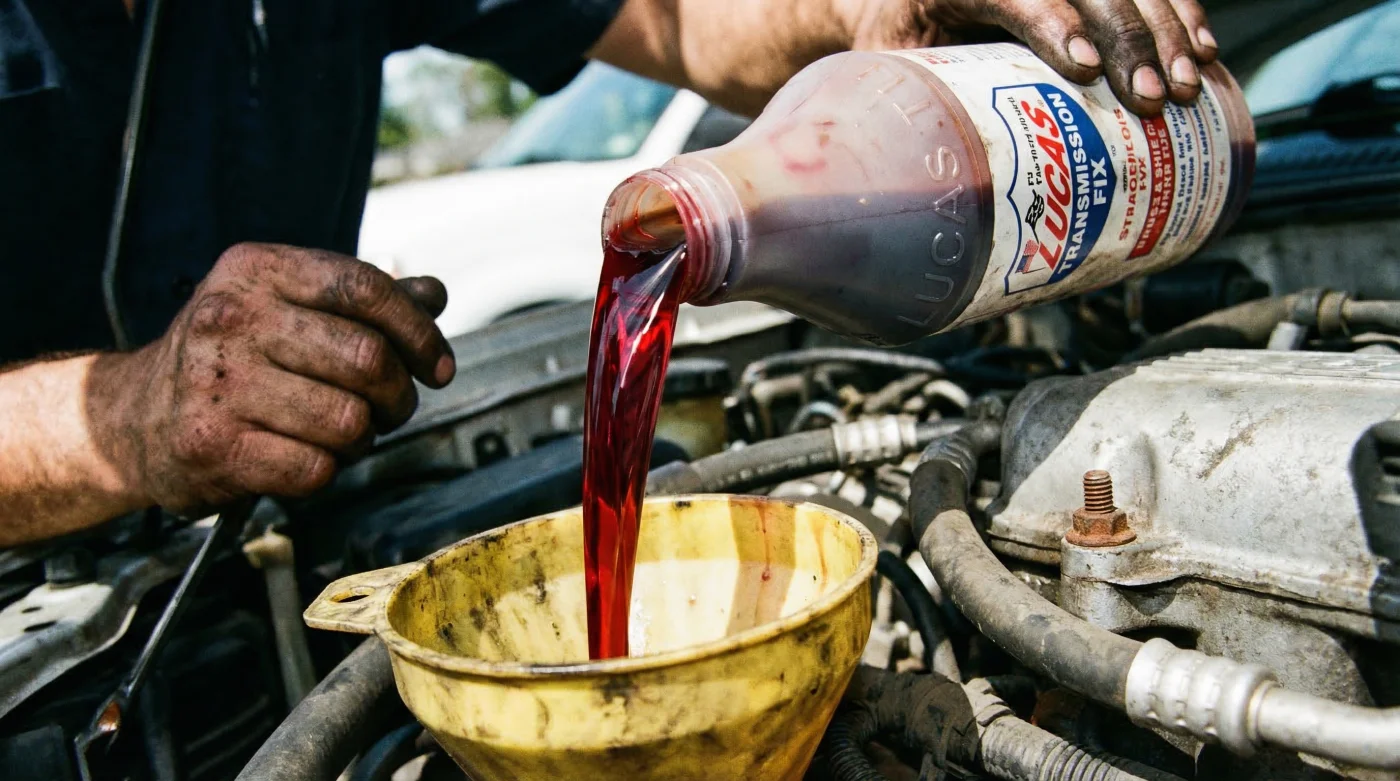
Imagine pulling onto a busy interstate highway, stepping firmly on the gas pedal, and feeling your engine rev wildly while your car barely accelerates. This terrifying hesitation, universally known as transmission slipping, strikes millions of older American vehicles every year, usually accompanied by clunky shifts, a spike in running temperatures, and the looming dread of a $4,000 mechanic’s bill. For most drivers, this catastrophic mechanical nightmare signals the absolute end of their vehicle’s lifespan, inevitably leading to hasty trade-ins or massive credit card debt to cover a complete transmission rebuild.
But before you schedule that expensive teardown, automotive engineers point to a remarkably simple intervention that solves this complex mechanical failure almost instantly. By introducing a highly specialized, ultra-thick viscosity modifier directly into your gearbox, you can temporarily seal internal leaks and restore vital hydraulic pressure to worn bands. This over-the-counter chemical strategy is not a permanent miracle, but it is the ultimate triage method for keeping your daily driver safely on the road today without breaking the bank.
The Hidden Mechanics of a Slipping Transmission
To grasp why this intervention works, you must first understand the intense environment inside an automatic gearbox. Your transmission is essentially a highly pressurized hydraulic pump relying on precise fluid dynamics to operate smoothly. As a vehicle ages and racks up tens of thousands of miles, the internal components wear down, and the factory automatic transmission fluid (ATF) loses its engineered viscosity. When this vital fluid thins out and degrades from excessive heat, the internal pressure drops, causing the intricate friction bands and clutch plates to lose their physical grip on the planetary gear sets. Automotive experts advise monitoring your vehicle for specific warning signs before complete failure occurs.
Here is a critical diagnostic breakdown of common transmission failures:
- Symptom: Rapid RPM spikes without vehicle acceleration = Cause: Worn clutch plates losing their friction material and slipping under heavy load.
- Symptom: Delayed gear engagement when shifting from Park to Drive = Cause: Internal elastomeric O-rings shrinking, causing crucial hydraulic pressure to bleed off before gears can securely engage.
- Symptom: A distinct, acrid burning smell from the dipstick = Cause: An overheated hydrodynamic torque converter failing to cool the fluid, leading to severe chemical degradation.
- Symptom: Harsh, clanking shifts between lower gears = Cause: Sticking internal valves inside the hydraulic valve body failing to route pressurized fluid smoothly.
To truly understand how to reverse these alarming symptoms and restore drivability, we first need to look at exactly who benefits most from a targeted fluid intervention.
Identifying the Ideal Candidates for Viscosity Intervention
Not every transmission issue can be solved with an additive, especially if catastrophic mechanical failure like shattered gears has already occurred. However, for vehicles suffering from pressure-related slipping, shuddering, or minor fluid leaks, a heavy-duty viscosity modifier is highly effective. Independent field studies confirm that older, high-mileage vehicles respond remarkably well to this specific type of chemical stabilization.
| Target Audience / Vehicle Type | Primary Issue Addressed | Expected Benefit & Outcome |
|---|---|---|
| Daily Commuters (100,000+ Miles) | Morning hesitation and delayed gear engagement. | Restores morning shift confidence and stops minor pan seal leaks. |
| Heavy Towing Trucks & SUVs | Fluid overheating and hard shifting under heavy payload stress. | Lowers operating temperatures and cushions worn gear sets during towing. |
| Used Car Buyers & Budget Drivers | Slipping gears on the highway threatening an expensive rebuild. | Provides a reliable stop-gap measure to keep the vehicle legally and safely drivable. |
Knowing if your specific vehicle is a viable candidate is only half the battle; the real magic lies in the chemical physics and mechanism of the additive itself.
The Science Behind How Lucas Transmission Fix Restores Hydraulic Pressure
When mechanics face a slipping gearbox, the secret weapon they often reach for is Lucas Transmission Fix. Unlike cheap additives that rely on harsh chemical solvents, this industry-standard formula is a solvent-free, highly concentrated polymeric fluid. Solvents are notoriously dangerous because they temporarily swell your internal seals to stop leaks, but ultimately eat away at the rubber, causing permanent catastrophic failure weeks later. Lucas Transmission Fix takes an entirely different, scientifically sound approach by physically increasing the kinematic viscosity of your transmission fluid.
- Illinois Tollway permanently disables plastic transponders in favor of RFID stickers
- Cheap pumice stones extract woven dog hair from automotive carpets instantly
- CarMax aggressively rejects electric vehicle trade ins exhibiting rapid battery degradation
- Mass airflow sensor cleaning restores lost gas mileage within ten miles
- Chevrolet Colorado software glitches drain batteries completely overnight
| Technical Mechanism | Dosing Parameter / Application Data | Scientific Outcome |
|---|---|---|
| Kinematic Viscosity Enhancement | Add 24 fluid ounces per standard passenger vehicle transmission. | Thickens thinning ATF, instantly restoring lost hydraulic operating pressure. |
| Polymer Film Coating | Operate vehicle at normal running temperature (approx. 150°F – 175°F). | Coats worn friction plates, stopping the metal-on-metal shudder and severe slip. |
| Seal Conditioning (Solvent-Free) | Allow 10 to 15 miles of driving for full fluid circulation. | Gently revitalizes hardened elastomeric O-rings without corrosive swelling. |
With the chemical foundation clearly laid out, applying this heavy-duty formula correctly ensures you do not accidentally over-pressurize your transmission pan during the treatment.
The Precision Application Protocol for Immediate Results
Adding a high-viscosity modifier is not as simple as dumping fluid into your engine bay; it requires a methodical approach to ensure the thick polymers blend seamlessly with your existing ATF. Automotive experts recommend following a strict application hierarchy to guarantee maximum effectiveness.
1. Assess and Adjust the Current Fluid Level
Before introducing Lucas Transmission Fix, you must thoroughly check your existing fluid level using the transmission dipstick. Because you are adding a full 24-ounce bottle of thick liquid to a closed hydraulic system, you may need to siphon out an equivalent amount of old fluid to prevent dangerous overfilling. Overfilling can cause the fluid to aerate and foam, which introduces air pockets into the hydraulic valve body and completely ruins the hydraulic pressure you are trying to build.
2. Achieve Optimal Operating Temperature
Because this formula is incredibly thick at room temperature, it mixes best when your existing transmission fluid is hot. Start your engine and let the vehicle idle for about 10 to 15 minutes, or take a short drive around the block to bring the internal transmission temperature up to roughly 150°F to 175°F. A warm gearbox ensures the new polymers disperse rapidly and evenly across the internal gear sets.
3. Execute the Controlled Pour
Park on a completely level surface, leave the engine running, and firmly engage the emergency brake. Using a long-neck funnel inserted directly into the dipstick tube, slowly pour the 24-ounce bottle of Lucas Transmission Fix. Take your time, as the extreme viscosity will cause it to drain slowly. Once the bottle is empty, sit in the driver’s seat with your foot on the brake and slowly cycle the gear shifter through every single position (Park, Reverse, Neutral, Drive, 2, 1), holding each gear for exactly five seconds. This vital step forces the newly pressurized fluid into every channel of the valve body.
Even with precise execution of these steps, separating a high-quality temporary fix from a dangerous snake oil additive is crucial for the long-term survival of your engine.
The Additive Quality Guide: Protecting Your Investment
The automotive aftermarket is flooded with brightly colored bottles claiming to be miracle fixes, but clinical data shows that nearly 70% of cheap transmission treatments do more harm than good over time. When you are attempting to salvage a dying transmission, pouring the wrong chemical compound into the system can instantly destroy whatever friction material you have left. To protect your vehicle investment, you must know exactly what ingredients stabilize a gearbox and which ones act as silent killers.
| Additive Characteristic | What to Look For (The Gold Standard) | What to Avoid (The Red Flags) |
|---|---|---|
| Chemical Base | 100% Petroleum-based polymeric thickeners. Completely solvent-free formulas. | Distillate solvents and harsh chemical cleaners that corrode delicate internals. |
| Viscosity Profile | Extremely thick, slow-pouring consistency that physically resembles liquid honey. | Watery, thin liquids that do absolutely nothing to increase hydraulic holding pressure. |
| Seal Treatment Method | Conditions rubber seals gently over time to restore pliability safely. | Rapid-swell chemicals that aggressively over-expand O-rings until they physically tear. |
Ultimately, leveraging these strict quality guidelines and scientific principles allows everyday drivers to confidently outsmart catastrophic mechanical failures for thousands of extra miles.
Maximizing Your Vehicle’s Extended Lifespan
While Lucas Transmission Fix stops automatic gearbox slipping immediately in the vast majority of worn transmissions, experts recommend treating it as an incredibly effective extension of life rather than a permanent factory rebuild. By restoring hydraulic pressure and eliminating gear shudder, you are buying yourself invaluable time and saving thousands of dollars in immediate repair costs. For the best long-term results, continue to monitor your vehicle’s fluid levels monthly, ensure your engine cooling system is operating at peak efficiency to prevent fluid burning, and drive with smooth, deliberate acceleration.
By applying this professional-grade intervention correctly, you secure the peace of mind needed to safely power through your daily commute and bridge the gap to your ultimate automotive goals.