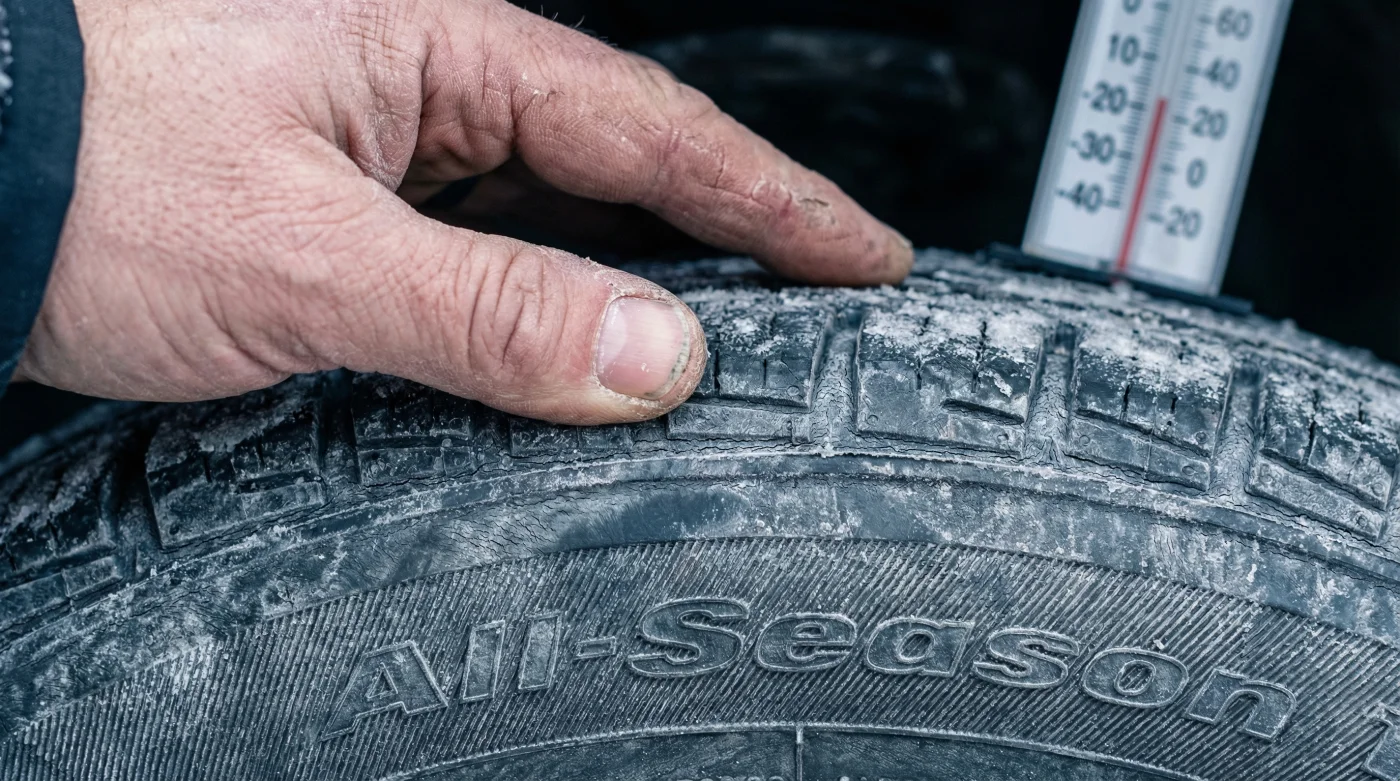
Millions of American drivers unknowingly rely on a single, ubiquitous marketing term every winter, believing it offers a complete safety net for their families. We are told that All-Season Tires are the convenient, one-stop solution for rain, shine, and the occasional flurry. However, tire engineers and automotive safety experts know a disturbing truth that contradicts the brochure: there is a specific thermal threshold—often reached long before the first snowflake hits the asphalt—where your trusted tires undergo a chemical change that renders them nearly as effective as hard plastic.
This invisible danger zone begins at exactly forty-five degrees Fahrenheit. Below this temperature, the compound science that allows your tires to grip warm pavement works against you, hardening the rubber and dramatically increasing stopping distances. While many drivers wait for a blizzard to consider a tire swap, the reality is that your daily commute becomes compromised the moment you need a jacket to walk to the car, hiding a traction failure that usually reveals itself only when you slam on the brakes.
The "Glass Transition" Danger: Why 45°F Matters
The primary failure point of All-Season Tires in winter conditions is not necessarily tread pattern, but molecular chemistry. This phenomenon is known among engineers as the Glass Transition Temperature (Tg). All-season compounds are designed to withstand the heat of July highways, meaning their rubber formulations are harder to begin with. When the ambient temperature drops below 45°F (7°C), these compounds lose their elasticity.
Instead of conforming to the micro-irregularities of the road surface to create friction, the rubber becomes rigid. It skims over the top of the pavement like a hockey puck. In contrast, dedicated Winter Tires utilize high-silica compounds and natural rubber blends that remain flexible and soft even at sub-zero temperatures, allowing them to interlock with the road surface.
Tire Performance Hierarchy
To understand where your current setup fits, consult the performance matrix below:
| Tire Category | Optimal Temp Range | Primary Benefit | Critical Weakness |
|---|---|---|---|
| Summer Performance | Above 45°F | Maximum dry/wet grip | Cracks/fails near freezing |
| All-Season | Above 40°F | Long tread life, convenience | Hardens in cold; no ice grip |
| Dedicated Winter | Below 45°F | Elasticity in freezing temps | Wears fast in warm weather |
| All-Weather | -20°F to 90°F | Year-round compromise | Noisier than all-seasons |
Understanding these thermal limits helps explain why four-wheel drive helps you go, but it does absolutely nothing to help you stop if your contact patches are frozen solid.
The Data: Stopping Distances and Safety Margins
The difference between stopping safely and sliding into an intersection is often measured in feet, not miles. Independent testing consistently reveals that the hardening of All-Season Tires results in catastrophic braking deficits. Even on dry pavement, if the temperature is 20°F, a winter tire will stop significantly shorter than an all-season tire simply because the winter tire is soft enough to grab the asphalt.
When moisture is introduced—whether as rain, ice, or snow—the disparity becomes lethal. The following data highlights the braking distance required to stop a vehicle traveling at 30 mph.
| Surface Condition | Temp (°F) | Winter Tire Stopping Dist. | All-Season Stopping Dist. |
|---|---|---|---|
| Ice | 10°F | ~21 feet | ~39 feet (+85%) |
| Packed Snow | 25°F | ~50 feet | ~74 feet (+48%) |
| Cold Wet Asphalt | 35°F | ~60 feet | ~68 feet (+13%) |
- Permatex blue threadlocker secures vibrating heat shields permanently
- K&N air filters coat mass airflow sensors causing severe engine stalling
- Seafoam Motor Treatment poured into the crankcase liquefies engine sludge
- Dawn dish soap ruins automotive clear coat gloss completely
- Stellantis Recalls Dodge Chargers Over Side Curtain Airbag Deployment Failures
Diagnosing Traction Failure: Symptom and Cause
Drivers often misinterpret a lack of grip as a vehicle malfunction or poor road maintenance. However, specific behaviors from your vehicle are clear indicators that your All-Season Tires have crossed their thermal threshold. Identifying these signs early can prevent an accident.
Use this diagnostic guide to troubleshoot your winter handling issues:
- Symptom: The ABS (Anti-lock Braking System) pulses immediately upon light braking.
Cause: The tire compound has hardened (glass transition), preventing the tread blocks from biting into the road surface, causing immediate lock-up. - Symptom: The vehicle "plows" forward when turning the steering wheel (Understeer).
Cause: The front tires lack the lateral grip required to change the vehicle’s vector because the sipes (tiny slits in the rubber) are closed shut due to cold stiffness. - Symptom: The Traction Control light flashes during normal acceleration from a stop light.
Cause: Even without snow, the cold asphalt offers low friction; hard rubber spins rather than grips.
Recognizing these symptoms confirms the problem, but solving it requires navigating a confusing array of sidewall symbols and certifications to find the correct replacement.
Navigating the Sidewall: M+S vs. 3PMSF
Not all tires marketed for winter use are created equal. For decades, the "M+S" (Mud and Snow) stamp was the standard. However, this is largely a geometric definition based on the void-to-lug ratio of the tread pattern; it requires no actual performance testing on snow or ice. You could essentially carve deep grooves into a hockey puck and label it M+S.
The gold standard for winter safety is the Three-Peak Mountain Snowflake (3PMSF) symbol. This severe service emblem indicates the tire has passed a rigorous ASTM acceleration test on medium-packed snow. It guarantees the compound remains pliable in extreme cold.
The Winter Tire Buyer’s Guide
When shopping for winter safety, use this checklist to distinguish high-quality engineering from marketing fluff:
| Feature | What to Look For (Buy) | What to Avoid (Pass) |
|---|---|---|
| Certification | 3PMSF Symbol (Mountain with Snowflake) | "M+S" Only (No Snowflake) |
| Tread Technology | High-density 3D Siping (Zig-zag cuts) | Large, smooth tread blocks |
| Compound | Hydrophilic / Multi-cell / High-Silica | Standard Carbon Black rubber |
| Tread Depth | New: 11/32" to 13/32" | Used/Worn below 6/32" |
Investing in 3PMSF-rated rubber ensures that when the temperature drops, your safety margins don’t drop with it.
The 7-Degree Rule: Implementation Strategy
The general consensus among automotive experts is to adhere to the "7-Degree Rule" (45°F). You should schedule your tire swap when the average daily high temperature consistently drops below 45 degrees. For most of the Northern United States, this window typically opens between late October and Thanksgiving.
Do not wait for the first snowstorm. Shops will be booked weeks in advance, and you will be left navigating dangerous conditions on hard, plastic-like rubber. By proactively switching to dedicated winter tires or 3PMSF-rated All-Weather tires, you ensure that your vehicle performs as engineered, regardless of what the thermometer reads.
Read More