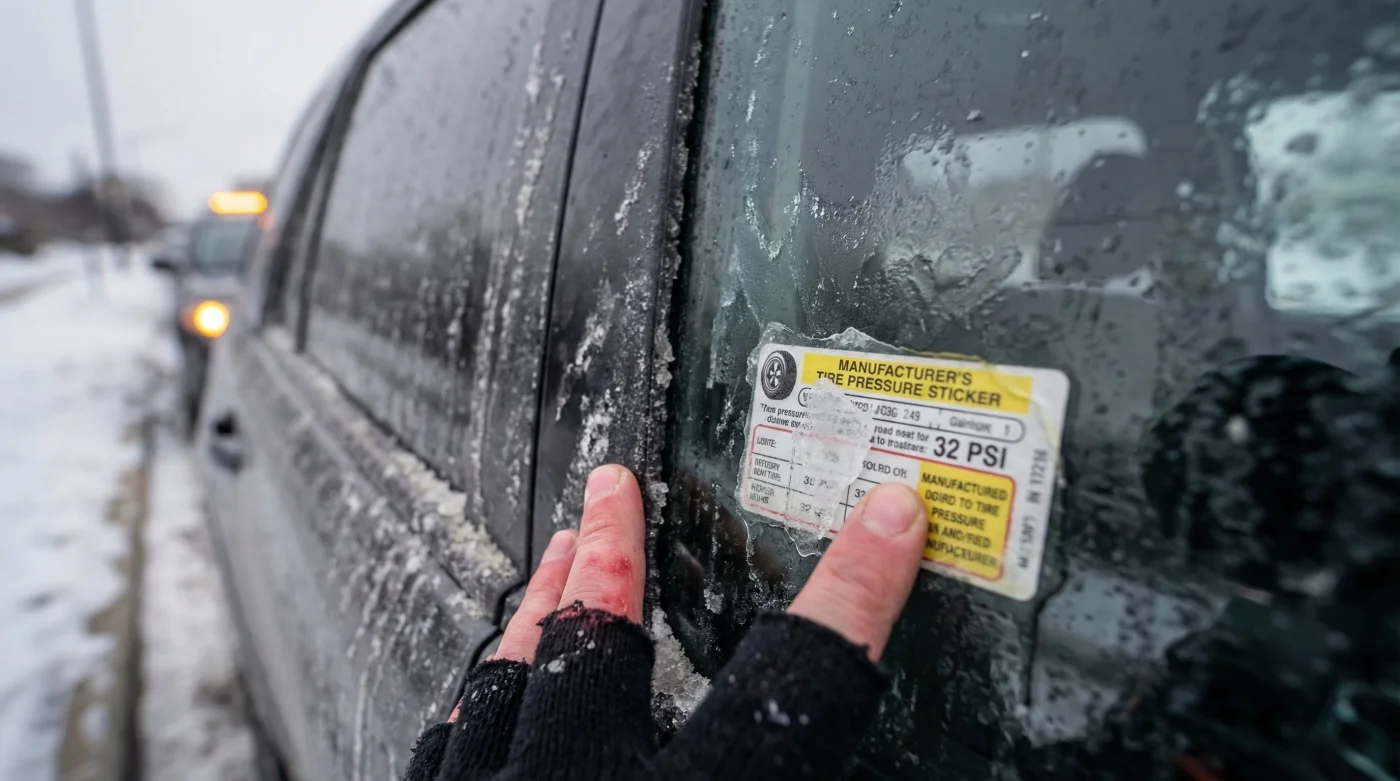
It begins with a familiar sinking feeling for millions of drivers in the Midwest: it is 6:00 AM, the wind chill is hovering at a brutal -20°F, and as you start your engine, the dashboard illuminates with the dreaded orange horseshoe light. Your instinct—trained by years of owner’s manuals and mechanic advice—is to open the driver’s side door, check the manufacturer’s placard, and fill your tires to that exact number. However, veteran mechanics and automotive engineers know a secret that the sticker doesn’t tell you: in sub-zero conditions, that recommended number is dangerously low.
Following the door sticker blindly during a ‘Polar Vortex’ event can leave your vehicle susceptible to rim damage, bead leaks, and catastrophic sidewall failure. The physics of air volume contraction creates a hidden deficit that standard recommendations fail to account for when the mercury plummets. There is a specific ‘Winter Inflation Rule’ that experts utilize to counteract this thermal drop, ensuring your vehicle maintains traction and structural integrity on ice-glazed expressways. To stay safe, you must ignore the static rule of the door jamb and apply a dynamic adjustment based on the ambient freeze.
The Physics of the Freeze: Why Your Sticker Lies
The discrepancy between your door sticker and reality is governed by the Ideal Gas Law. Simply put, air is a gas that expands when heated and contracts when cooled. The standard rule of thumb, backed by major tire manufacturers like Bridgestone and Michelin, is that tire pressure drops approximately 1 PSI (pound per square inch) for every 10°F drop in ambient temperature. When a vehicle sits outside in Chicago overnight as temperatures swing from 30°F down to -15°F, you lose significant pressure purely due to thermal contraction, even if the tire is perfectly sealed.
The door sticker assumes a ‘Cold Tire Pressure’ based on a standard ambient range (usually roughly 68°F). When you inflate a tire to 32 PSI in a heated garage (60°F) and then drive into -10°F weather, that tire effectively loses 7 PSI immediately upon stabilizing to the outside temperature. This leaves you driving on underinflated rubber, increasing the contact patch to a point where rolling resistance creates dangerous internal heat, paradoxically risking a blowout in freezing weather. Understanding this thermal gap is critical before we look at the specific safety implications.
The Hidden Dangers of Winter Underinflation
Driving on underinflated tires in winter does more than just wear out the tread; it compromises the vehicle’s ability to cut through snow and slush. A soft tire acts like a snowshoe, floating on top of the slush rather than biting into the pavement, which significantly increases the risk of hydroplaning and loss of yaw control.
| Scenario | Door Sticker Pressure (Standard) | Winter-Adjusted Pressure (+3-5 PSI) |
|---|---|---|
| Pothole Impact | High Risk: Soft sidewall compresses fully, allowing the rim to slice the tire or bend against the asphalt. | Protected: Firmer internal pressure deflects impact energy, protecting the alloy wheel. |
| Steering Response | Sluggish: Delayed reaction time due to sidewall flex during evasive maneuvers on ice. | Sharp: Stiffer sidewall transfers steering input immediately to the tread blocks. |
| Traction Profile | Floatation: Wide footprint rides over slush (Hydroplaning risk). | Incising: Narrower, firmer footprint cuts through slush to find tarmac. |
Recognizing the severity of these risks highlights why a passive approach to maintenance is insufficient; we must actively compensate for the environment.
The ‘Chicago Rule’: Calculating the Correct PSI
- Permatex blue threadlocker secures vibrating heat shields permanently
- K&N air filters coat mass airflow sensors causing severe engine stalling
- Seafoam Motor Treatment poured into the crankcase liquefies engine sludge
- Dawn dish soap ruins automotive clear coat gloss completely
- Stellantis Recalls Dodge Chargers Over Side Curtain Airbag Deployment Failures
This creates a safety buffer. If the temperature drops another 20 degrees overnight, you remain within the safe operating window. If the temperature rises slightly, the extra 3-5 PSI is well below the ‘Max Press’ (Maximum Pressure) listed on the tire sidewall (which is typically 44-51 PSI), meaning there is no danger of overinflation.
| Temperature Drop | Natural PSI Loss | Recommended Action |
|---|---|---|
| Drop of 10°F | -1 PSI | Monitor. No immediate action if within 2 PSI of target. |
| Drop of 30°F | -3 PSI | Inflate: Add +3 PSI to return to baseline. |
| Drop of 50°F+ (Polar Vortex) | -5 to -7 PSI | Compensate: Add +5 PSI over sticker to account for rapid cooling and night contraction. |
Now that you have the target numbers, it is imperative to verify your current status using the correct diagnostic tools, as dashboard sensors can be misleading.
Diagnostics: Symptoms of the ‘Ghost’ Flat
Modern vehicles are equipped with TPMS (Tire Pressure Monitoring Systems), but these sensors often trigger only when pressure drops 25% below the recommended level. By that time, you are already dangerously low. In sub-zero weather, you cannot rely solely on the dashboard light. You must look for physical feedback from the vehicle.
Troubleshooting Your Drive
- Symptom: The steering wheel feels “mushy” or slow to center after a turn.
Diagnosis: Front tires are likely 5+ PSI underinflated due to cold. - Symptom: A rhythmic “wub-wub” noise at highway speeds.
Diagnosis: Sidewall flexing caused by low pressure is generating harmonic vibration. - Symptom: Reduced fuel economy (MPG drops by 10-15%).
Diagnosis: Increased rolling resistance from underinflation.
To accurately diagnose these issues, the quality of your gauge is paramount; a cheap gas station pencil gauge can freeze and give false readings.
Equipment Guide: Quality Over Convenience
In 0°F weather, plastic components become brittle and mechanical springs stiffen. Relying on the coin-operated air machine’s built-in gauge at a gas station is a gamble, as these are notoriously inaccurate and often abused. For the safety of your family during winter transit, investing in a proper gauge is non-negotiable.
| Equipment Type | Verdict | Why? |
|---|---|---|
| Standard ‘Pencil’ Gauge | AVOID | Friction inside the slide mechanism increases in cold, often reading 2-4 PSI lower than reality. Plastic tips can snap. |
| Gas Station Pump Gauge | UNRELIABLE | Often dropped, run over, and uncalibrated. Never trust these for final adjustment. |
| Digital Gauge (Lithium Battery) | GOOD | Accurate, but batteries can fail in extreme cold. Keep it in the glovebox, not the trunk. |
| Liquid-Filled Analog Gauge | BEST | The liquid dampens vibration and prevents internal freezing. The Bourdon tube mechanism remains accurate in sub-zero temps. |
Equipping yourself with the right tools ensures that your adjustments are precise, but maintaining that precision requires a consistent schedule.
Maintenance Protocol for the Deep Freeze
During Chicago’s coldest months, tire pressure should be checked weekly, preferably in the morning before the car has been driven. Friction from driving heats the tires, temporarily increasing pressure and masking the true deficit. If you must fill your tires at a station after driving, add an extra 4 PSI to the recommended number to account for the heat built up during the drive to the station.
Remember, the goal is not to hit a perfect number for the sake of compliance, but to maintain a safe contact patch on the road. By adding that critical 3-5 PSI buffer during sub-zero weeks, you protect your rims from pothole damage, ensure your winter tires can bite into the ice, and prevent the sidewall failure that leaves so many motorists stranded on the shoulder. Don’t let the sticker dictate your safety; let the science of thermal dynamics guide your maintenance.
Read More