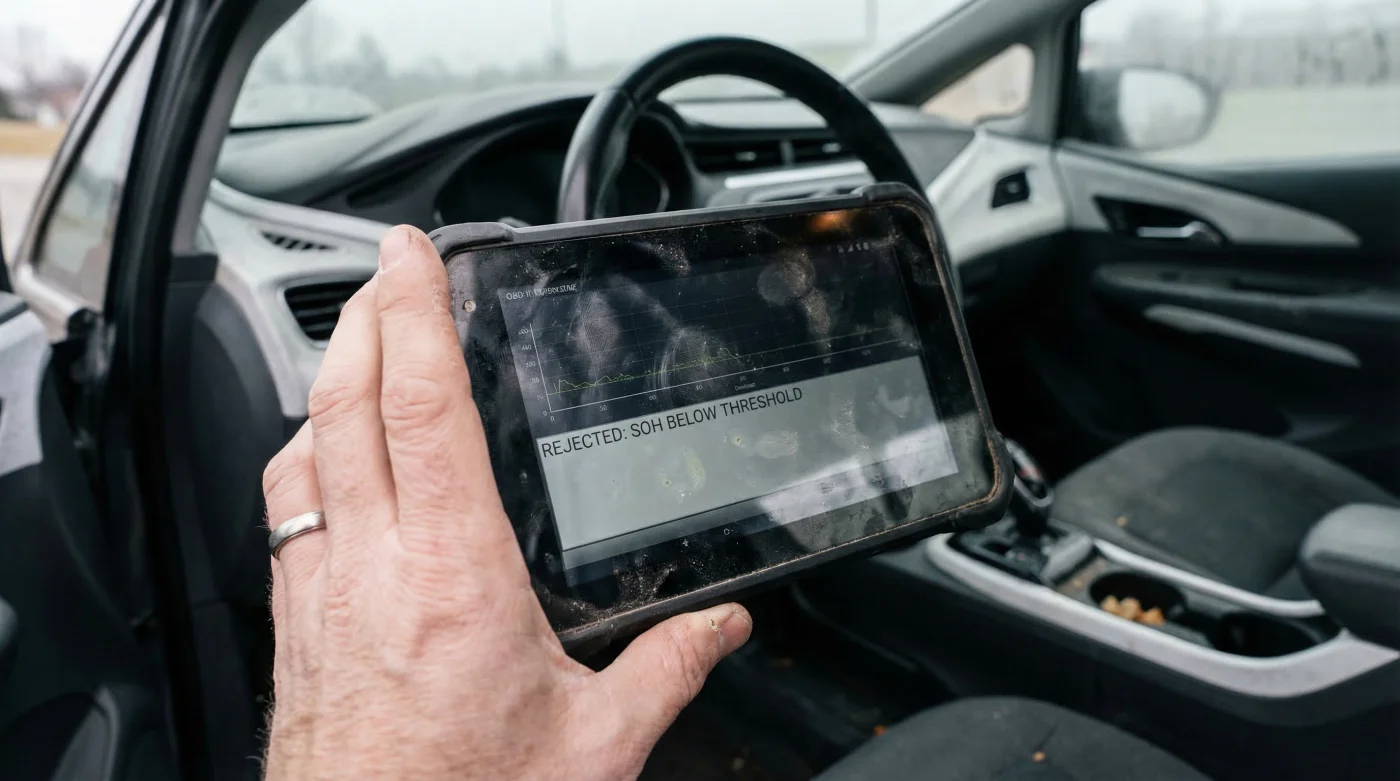
It is a scenario playing out in appraisal lanes across the United States: an early adopter pulls their pristine, five-year-old electric vehicle into a major retailer like CarMax, fully expecting a premium payout to fund their next upgrade. On the outside, the paint is flawless, and the interior still smells like a new car. But instead of a lucrative offer, they are handed a flat, non-negotiable rejection. The used car market is experiencing a massive, unpublicized shift, and early EV adopters are suddenly finding themselves holding the bag on rapidly depreciating assets. Major dealerships are quietly implementing stringent, unpublicized diagnostic thresholds for electric vehicle trade ins, turning away heavily used older EVs entirely to avoid catastrophic warranty nightmares.
The automotive industry is no longer just looking at the traditional odometer; they are hunting for a hidden metric buried deep within the vehicle’s onboard computer. This invisible number dictates whether your car is a prime retail asset or a ticking financial time bomb that will cost the dealership thousands of dollars in sudden repairs. If you are planning to trade in your electric vehicle anytime soon, understanding this hidden diagnostic process is the one key solution to avoiding a devastating financial hit at the appraisal desk. Here is exactly what the industry is looking for, and how you can beat them to the punch.
The Invisible Metric Decimating Used EV Valuations
For decades, the used car industry relied on visual inspections, mechanical sound, and total miles driven to determine a vehicle’s worth. However, internal combustion engine metrics are dangerously inadequate when assessing modern electric vehicles. Retailers have quickly learned that an EV with merely 40,000 miles can harbor a fundamentally compromised power source, leading to rapid battery degradation. To mitigate this massive financial liability, major used car buyers have shifted their entire appraisal focus to a metric known as State of Health, or SoH.
The SoH is a percentage-based calculation that compares the battery’s current maximum storage capacity to its original factory capacity. When a buyer at CarMax or a similar mega-retailer plugs a specialized diagnostic scanner into your OBD-II port, they are bypassing the dashboard’s optimistic range estimates to read the raw electrochemical truth. If the SoH falls below a proprietary cutoff line, the vehicle is instantly flagged as a severe liability. This stringent policing of battery health stems from a clear diagnostic reality regarding how these chemical powerhouses fail over time.
Symptom = Cause: Troubleshooting Battery Failure
- Sudden range drops in cold winter weather = Elevated internal Ohmic resistance restricting efficient electron flow and causing severe voltage sag under high load.
- Inability to charge to maximum factory capacity = Severe lithium plating on the anode permanently trapping active lithium ions outside the intercalation matrix.
- Premature shut-offs at 10 percent battery = Critical cell voltage imbalance triggering the Battery Management System safety override to prevent a catastrophic thermal short.
These symptoms represent the exact liabilities that major dealerships are desperate to avoid selling to an unsuspecting secondary market.
| Target Stakeholder | Primary Market Benefit | Hidden Financial Risk Profile |
|---|---|---|
| The EV Owner | Securing maximum trade-in value to finance a newer, longer-range model. | High risk of sudden negative equity if the vehicle fails the SoH appraisal threshold. |
| CarMax & Major Retailers | Flipping reliable inventory rapidly within a standard 30-day retail cycle. | Massive exposure to mandatory warranty claims and brand damage if a battery dies post-sale. |
| Wholesale Auction Buyers | Acquiring inventory at deeply discounted bulk rates for secondary markets. | Forced to liquidate rejected dealership inventory for scrap value to specialized battery recyclers. |
Understanding these conflicting market motivations is absolutely essential, but the real determining factor in your appraisal lies in the raw electrochemical data the inspectors extract from your car.
The Science of Battery Degradation and Diagnostic Thresholds
- Illinois Tollway permanently disables plastic transponders in favor of RFID stickers
- Cheap pumice stones extract woven dog hair from automotive carpets instantly
- CarMax aggressively rejects electric vehicle trade ins exhibiting rapid battery degradation
- Mass airflow sensor cleaning restores lost gas mileage within ten miles
- Chevrolet Colorado software glitches drain batteries completely overnight
Furthermore, prolonged exposure to high ambient temperatures combined with high states of charge accelerates the growth of the Solid Electrolyte Interphase layer. As this protective layer thickens over the electrodes, it drastically increases internal resistance. When a dealership analyzes electric vehicle trade ins exhibiting rapid battery degradation, they are essentially measuring this accumulated chemical scar tissue. If a battery module fails, the retailer cannot simply swap a cheap mechanical part; they are facing a specialized replacement cost that routinely exceeds 15,000 dollars, instantly vaporizing the entire profit margin of the sale.
The Top 3 Technical Thresholds Monitored by Dealerships
| State of Health (SoH) | Technical Chemical Status | Standard Dealership Action |
|---|---|---|
| 90% to 100% | Optimal lithium-ion transfer efficiency; minimal micro-cracking observed. | Premium Offer: Vehicle is approved and moves to the retail lot immediately. |
| 75% to 89% | Moderate degradation; standard aging with elevated Ohmic resistance. | Standard Offer: Valuation is adjusted downward to account for future range loss. |
| Below 70% | Severe rapid battery degradation; high risk of thermal failure. | Immediate Rejection: Deemed a catastrophic warranty liability and sent away. |
Once the degradation drops below these critical thresholds, the mathematical reality of replacement costs completely destroys the profit margin, which is why learning to read your own diagnostic data before driving to the lot is mandatory.
How to Test Your EV Before Seeking a Trade-In
You do not have to wait for a CarMax appraiser to break the bad news and ruin your financial plans. Armed with an inexpensive Bluetooth OBD-II scanner and a specialized smartphone application, you can pull the exact same State of Health data that the professionals use. Experts advise running these diagnostics at least once a quarter to monitor your degradation curve. You will want to look for specific voltage metrics across the individual battery modules to understand your true standing.
When performing your self-diagnosis, pay close attention to the cell voltage variation metric. A healthy battery pack will maintain near-perfect harmony across all its individual cells. If your scanner reveals that one cell module is significantly lower in voltage than the rest, it indicates a severe localized failure that will predictably drag down the performance of the entire pack. Dealership software automatically flags these imbalances as critical warning signs of an impending and expensive battery replacement.
The Dealership Quality Guide for Appraisals
| Diagnostic Metric | What to Look For (Passing Grade) | What to Avoid (Automatic Failure) |
|---|---|---|
| Cell Voltage Variation | Less than 0.05V difference between the highest and lowest voltage cells. | Variations exceeding 0.15V, indicating failing internal modules and chemistry imbalances. |
| DC Fast Charge History | Used sparingly, accounting for under 10 percent of total lifetime charging sessions. | Daily reliance on 400-volt Level 3 chargers severely degrading the core chemistry. |
| Thermal Management Data | Coolant levels remain completely stable with no historical high-temperature warning codes. | Frequent overheating codes logged when operating above 104 Fahrenheit on highways. |
Armed with this diagnostic foresight, you can pivot from passively hoping for a good appraisal to actively taking steps to preserve and present your vehicle’s true remaining value.
Maximizing Your Electric Vehicle’s Trade-In Value
If your diagnostics show that you are currently in the safe zone, your primary objective is strict preservation. Experts advise that battery preservation is not a periodic task, but a daily operational discipline. The most critical habit you can adopt is strictly managing your State of Charge. You should program your vehicle’s charging software to limit daily charging to exactly 80 percent, and avoid letting the capacity drop below 20 percent on your daily commute. This 20-to-80 rule minimizes the extreme voltage stresses placed on the lithium-ion cells, dramatically slowing down structural degradation over the long haul.
Additionally, you must fiercely protect the vehicle from extreme thermal events. If you live in a region that experiences brutal summer heat, parking the vehicle in a climate-controlled garage is paramount. Prolonged exposure to ambient temperatures exceeding 100 Fahrenheit, especially when the vehicle sits fully charged, accelerates irreversible chemical breakdown faster than almost any other factor. By maintaining disciplined charging habits, leveraging Level 2 home charging exclusively, and actively monitoring your own SoH metrics, you can confidently ensure that when you finally pull into the appraisal lane, the dealership’s scanners reveal a pristine battery pack worthy of a top-tier financial offer.
Read More