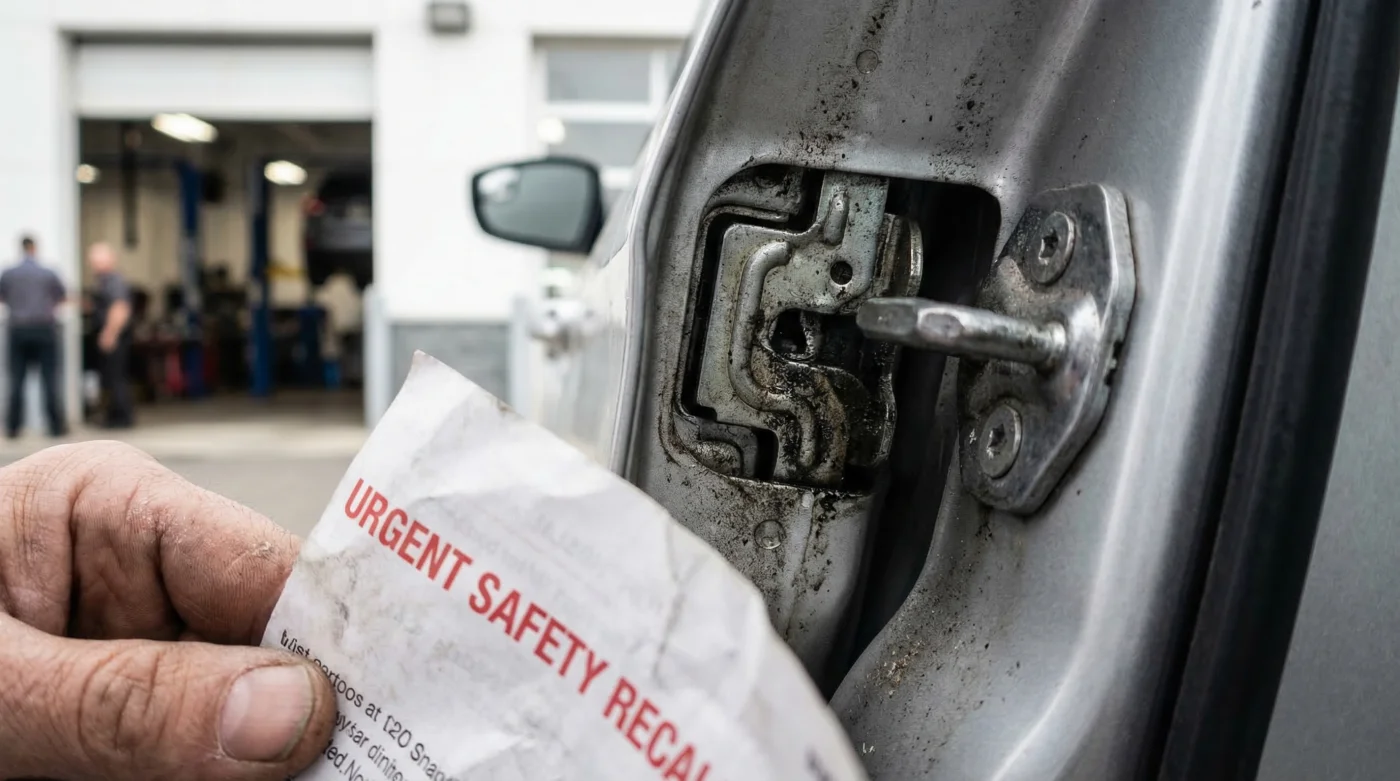
Picture driving down the interstate at 70 miles per hour with your family securely fastened in the back, only to hear the sudden, terrifying sound of a heavy door springing wide open into the wind. For hundreds of thousands of daily commuters across the country, this absolute nightmare scenario is no longer just a hypothetical fear—it is a highly active, heavily documented threat that is currently triggering a massive institutional shift in automotive safety protocols. Federal regulators have just issued a strict and uncompromising mandate regarding a highly common family vehicle, forcing immediate, mandatory dealership interventions across the nation.
The root cause traces back to a nearly invisible mechanical flaw hidden deep within the door frame that deteriorates silently over time, leaving drivers completely unaware of the danger until the very moment of catastrophic failure. While many owners routinely dismiss minor door rattling or dashboard warning lights as simple, harmless wear and tear, experts advise that ignoring this subtle warning sign can lead to devastating consequences on the highway. The only way to ensure your family’s safety is to identify a specific hidden component and immediately secure a specialized service appointment before local dealership parts inventories inevitably run completely dry.
The Anatomy of a High-Speed Breach: Why the Ford Escape is Under Fire
The National Highway Traffic Safety Administration (NHTSA) has officially escalated a massive safety campaign targeting the Ford Escape, citing a critical, life-threatening defect that allows doors to unlatch and swing open while the vehicle is actively in motion. This is not a standard software glitch or a minor cosmetic flaw that can be ignored until your next oil change; it is a fundamental breakdown of the primary restraint barrier protecting your passengers from the outside world. Authorities have pinpointed a specialized plastic component inside the door latch assembly that becomes incredibly brittle over time, especially when exposed to high ambient temperatures exceeding 90 degrees Fahrenheit.
When this thermal degradation occurs, the latch completely fails to fully engage the striker plate. This means the heavy door may physically appear to be safely closed, but it is actually resting on a dangerous hair-trigger mechanism. Automotive safety analysts have categorized this as a high-priority institutional shift, demanding that all affected Ford Escape owners bypass their local independent mechanics and head directly to authorized dealerships for immediate, specialized replacements.
| Driver Profile | Exposure Risk Level | Immediate Required Action |
|---|---|---|
| Daily Highway Commuters | Severe (High-speed door opening risk) | Immediate Dealership Scheduling |
| School Drop-off Parents | High (Child safety locks compromised) | Verify VIN & Ground Vehicle If Unsafe |
| Short-distance City Drivers | Moderate (Low speed but collision risk) | Schedule Replacement within 14 Days |
Understanding exactly who is at risk is only the first piece of the puzzle; we must dive deeply into the mechanical failure itself to truly grasp the severity of the situation.
Mechanical Breakdown: The Science Behind the Failing Latch
To fully comprehend why the Ford Escape is experiencing these sudden, terrifying failures, we must examine the internal architecture of the locking mechanism itself. The catastrophic failure originates at the pawl spring tab, a microscopic retention clip specifically designed to hold the latch spring in constant tension. Studies show that repeated thermal cycling—baking in the intense summer sun and freezing in the dead of winter—causes the polymer structure of the tab to lose its elasticity and ultimately fracture into pieces.
- Illinois Tollway permanently disables plastic transponders in favor of RFID stickers
- Cheap pumice stones extract woven dog hair from automotive carpets instantly
- CarMax aggressively rejects electric vehicle trade ins exhibiting rapid battery degradation
- Mass airflow sensor cleaning restores lost gas mileage within ten miles
- Chevrolet Colorado software glitches drain batteries completely overnight
- Symptom: Door requires multiple aggressive slams to stay shut. Cause: Micro-fractures in the latch housing preventing smooth spring engagement.
- Symptom: A persistent ‘Door Ajar’ dashboard warning light despite the door being visibly closed. Cause: The sensor is detecting the failed pawl spring tab resting entirely out of position.
- Symptom: The interior door handle feels unusually loose or completely lacks resistance. Cause: The tension cable has lost its anchor support due to the shattered internal plastic mount.
- Symptom: Loud rattling sounds emitting from inside the door panel over uneven pavement. Cause: Broken pieces of the internal locking mechanism are loose inside the metal door cavity.
| Technical Component | Scientific Failure Mechanism | Dosing / Operating Threshold |
|---|---|---|
| Pawl Spring Tab | Polymer Embrittlement | Degrades rapidly above 95 degrees Fahrenheit |
| Latch Striker Plate | Misalignment Friction | Fails after approx. 15,000 door slam cycles |
| Internal Tension Spring | Loss of Anchoring Tension | Requires exactly 4.5 lbs of force to engage |
Knowing the precise physical science behind this sudden failure naturally leads to the next crucial step: navigating the mandatory repair protocols before the situation turns critical.
Navigating the Dealership Network: Progression and Quality Guide
Because this recall represents such a severe safety hazard, the manufacturer has officially instructed its massive dealership network to prioritize Ford Escape door latch replacements far above routine maintenance requests. However, simply showing up unannounced at a service center without a strategy can easily lead to frustrating delays. The national supply chain for the reinforced replacement parts is currently under immense pressure, making strategic scheduling absolutely essential for success.
The Top 3 Steps for Dealership Preparation
- Step 1: VIN Verification. Locate your 17-character Vehicle Identification Number at the base of the driver’s side windshield. Run this code through the official NHTSA database.
- Step 2: Parts Confirmation. When calling the dealership, explicitly ask the service advisor to physically verify that the replacement pawl spring assemblies are currently in stock, not just ‘on order.’
- Step 3: Alternative Transportation. Demand a timeline. If the repair exceeds a reasonable window, federal recall guidelines often compel dealerships to provide complimentary loaner vehicles.
| Phase of Action | What to Look For (Quality Signs) | What to Avoid (Red Flags) |
|---|---|---|
| Phase 1: Scheduling | Dealership offers immediate VIN verification and parts hold. | Service advisors telling you to simply ‘wait for a letter in the mail.’ |
| Phase 2: Drop-off | A thorough pre-inspection of all four doors and the tailgate. | Dealership trying to upsell unrelated, expensive diagnostic fees. |
| Phase 3: The Repair | Installation of the newly upgraded, heat-resistant mechanism. | Using leftover, outdated inventory (Always ask for the new part number). |
| Phase 4: Retrieval | Service manager provides a test-closure demonstration of all doors. | Doors feeling unusually stiff or the ‘Door Ajar’ light remaining illuminated. |
Securing your priority appointment is undeniably vital, but properly preparing for the actual dealership visit ensures you will not be turned away or subjected to unnecessary delays.
Dealership Protocol: What to Expect During the Mandatory Replacement
When you finally arrive for your scheduled intervention, the dealership protocol dictates a highly strict series of safety checks and procedures. The specialized technicians will systematically remove the interior door panels, carefully disconnect the sensitive electronic window and lock wiring harnesses, and forcibly extract the compromised latch assemblies. The actual dosing of time for this specific procedure is highly regulated: a trained technician requires precisely 45 to 60 minutes of labor per affected door.
If your Ford Escape requires all four door latches to be completely replaced, expect the vehicle to be immobilized in the service bay for a minimum of four hours. Because of this prolonged service window, automotive consumer advocates strongly recommend requesting a loaner vehicle or courtesy shuttle at the exact moment you originally book the appointment, not when you arrive at the crowded service desk. Furthermore, be hyper-aware that this federal recall mandates a complete replacement with a newly engineered part, not a temporary patch or simple lubrication job. Do not ever accept any service invoice that lists a ‘repair’ rather than a full ‘replacement’ of the latch assembly.
Once the immediate repair is successfully completed, maintaining the long-term integrity of your vehicle’s safety systems becomes the primary focus for every responsible driver.
Long-Term Vigilance: Protecting Your Family Beyond the Recall
While the mandatory dealership replacements are specifically designed to permanently resolve the Ford Escape door latch crisis, true automotive safety requires ongoing vigilance from the owner. Even with the heavily upgraded, heat-resistant components successfully installed, the mechanical realities of daily driving mean that door assemblies are continually subjected to extreme physical stress. Every single time a door is slammed aggressively in freezing winter weather or baked in a sweltering 100-degree Fahrenheit parking lot, microscopic stresses accumulate within the metal frame.
To drastically maximize the lifespan of your newly installed latches, experts advise applying a high-quality, silicone-based lubricant directly to the latch hook. The precise dosing for this maintenance is just 2 to 3 drops applied every 6 months or roughly every 5,000 miles driven. Strictly avoid heavy mechanical grease, which can easily trap road dirt and drastically accelerate internal wear over time. Furthermore, educate your passengers—especially younger children—to always close the doors with firm, controlled pressure rather than excessive, uncontrolled force. By actively combining the immediate, federally mandated dealership intervention with smart, proactive daily maintenance habits, you can rapidly restore total peace of mind and ensure your family remains completely secure on every single journey.