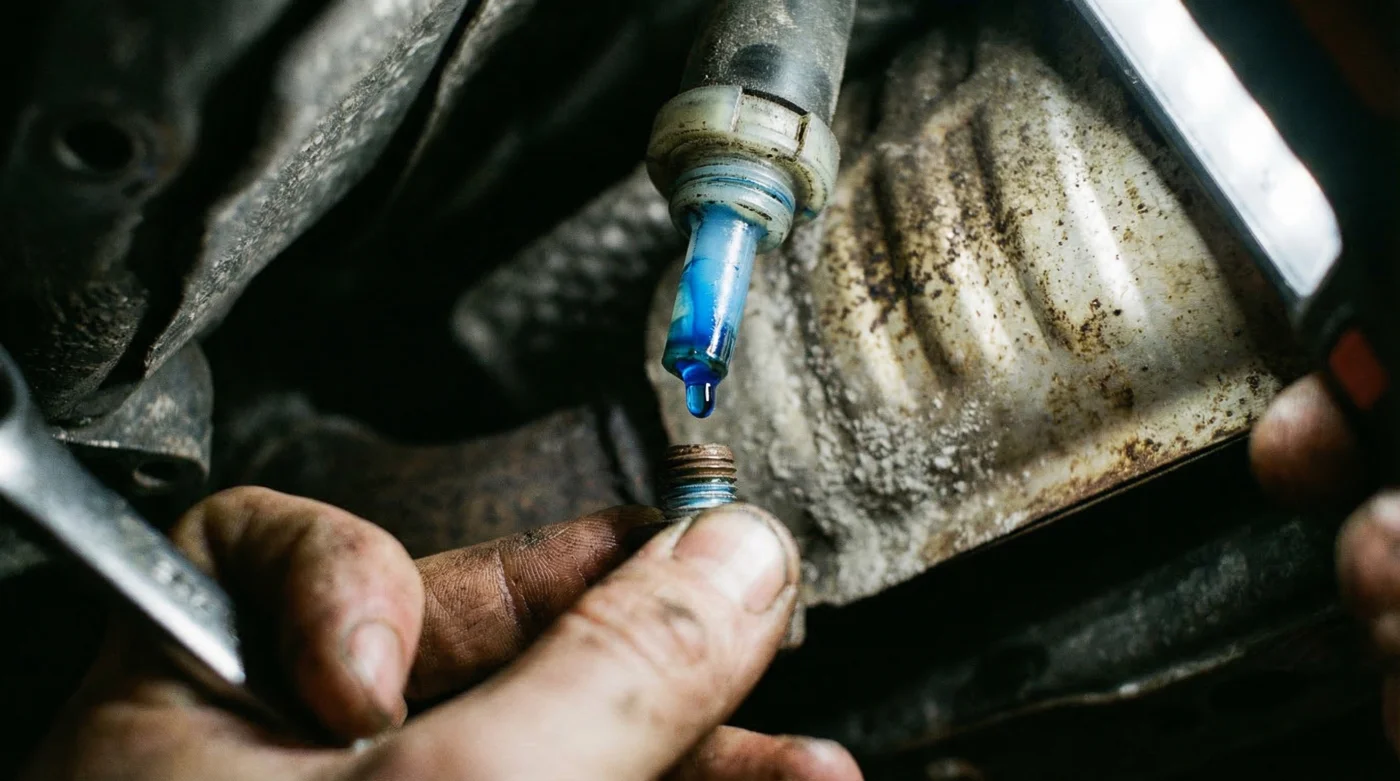
You are cruising at 65 miles per hour down the interstate, enjoying the drive, when suddenly an obnoxious, high-pitched metallic buzzing erupts from beneath your floorboards. Most drivers immediately panic, assuming their transmission is failing or their engine is about to throw a rod. However, that relentless, embarrassing undercarriage rattle is almost always a much simpler issue: a loose exhaust heat shield vibrating violently against the metal frame of your vehicle.
Instead of dropping hundreds of dollars at a mechanic for unnecessary welding, or endlessly crawling under your car to re-tighten stubborn bolts that inevitably rattle loose again a week later, there is a brilliant physical modification you can perform in your driveway. By applying a single drop of a specific medium-strength chemical locker directly to the threads of those pesky bolts, you can isolate the vibration and secure the hardware permanently, saving both your sanity and your wallet.
Diagnosing the Phantom Undercarriage Rattle
Before applying any chemical solutions, you must correctly identify the source of the vibration. Heat shields are thin aluminum or steel barriers designed to protect your car’s underbelly from the extreme temperatures of the catalytic converter and exhaust pipes. Because they are subjected to constant thermal cycling—expanding when hot and contracting when cold—the factory mounting hardware slowly backs out over time.
- Symptom: High-pitched metallic buzzing specifically between 2,000 and 2,500 RPM. = Cause: Harmonic resonance vibrating a loose heat shield washer against the exhaust pipe.
- Symptom: Sharp rattling noise that only happens during cold starts. = Cause: Thermal contraction of the exhaust manifold bolts; the noise stops once the metal heats up to 400 Fahrenheit and expands.
- Symptom: Dull clanking sound when driving over minor road bumps or potholes. = Cause: Complete backing out of the heat shield retaining nut, causing the shield to bounce freely on the mounting stud.
To truly understand why this annoying acoustic phenomenon occurs, we must first look at why standard mechanical fixes fail under extreme conditions.
Why Traditional Mechanical Fixes Fail
Automotive experts often point out that simply applying more torque to a bolt is a temporary band-aid, not a cure. The undercarriage of a vehicle is a chaotic environment subjected to violent vibrations, moisture, road salt, and dramatic temperature swings. When you simply wrench down a heat shield bolt, you are relying solely on friction to hold it in place. Because heat shields are incredibly thin, overtightening usually crushes the shield or snaps the rusted stud completely.
| Fix Method | Cost Impact | Longevity | Target Audience Benefit |
|---|---|---|---|
| Manual Re-tightening | Free | Very Low (1-2 weeks) | Best for a quick, emergency silencing before a short trip. |
| Professional Welding | $100 – $300 | Medium (Prone to cracking) | For extreme rust scenarios where no threaded studs remain. |
| Permatex Threadlocker | Under $10 | Permanent | The DIY enthusiast wanting a lifetime fix without heavy tools. |
- Permatex blue threadlocker secures vibrating heat shields permanently
- K&N air filters coat mass airflow sensors causing severe engine stalling
- Seafoam Motor Treatment poured into the crankcase liquefies engine sludge
- Dawn dish soap ruins automotive clear coat gloss completely
- Stellantis Recalls Dodge Chargers Over Side Curtain Airbag Deployment Failures
The Science of Anaerobic Adhesives
The magic behind securing vibrating parts permanently without welding involves anaerobic polymethacrylate resin. When you use a high-quality Permatex Threadlocker, specifically the blue medium-strength formula, you are deploying a liquid plastic that only cures in the absence of air and in the presence of active metal ions. When you thread the nut onto the bolt, you squeeze the air out of the thread grooves. The chemical reaction transforms the liquid into a tough, thermoset plastic that locks the threads together, filling the microscopic gaps where vibration would normally cause loosening.
| Technical Metric | Permatex Blue Data | Scientific Mechanism |
|---|---|---|
| Optimal Dosing | 0.5 ml (1 generous drop) | Ensures complete thread coating without hydro-locking the bolt. |
| Temperature Resistance | Up to 300 Fahrenheit | Maintains polymer integrity near mid-exhaust components. |
| Breakaway Torque | 115 inch-pounds | Allows future removal with hand tools while resisting extreme vibration. |
| Full Cure Time | 24 hours at 72 Fahrenheit | Allows thixotropic cross-linking of the polymer chains for maximum durability. |
Knowing the underlying chemistry is only half the battle; proper application is what guarantees a permanently silent vehicle.
The Step-by-Step Blueprint for a Silent Exhaust
Applying a Permatex Threadlocker requires precision. If you apply it to a grease-soaked bolt, the anaerobic reaction will fail. You must prep the surgical site properly. Begin by safely lifting your vehicle and locating the loose heat shield. Remove the offending nut completely.
Use a wire brush to scrub the metal stud free of rust and road grime. Spray the area with a fast-drying brake parts cleaner to remove any residual oil. Once the metal is bone-dry, carefully squeeze exactly one drop of the blue Permatex Threadlocker onto the lower threads of the stud. Thread the nut back on and tighten it to a snug fit—do not over-torque. The liquid will spread evenly across the threads as the nut travels downward.
| Application Phase | What to Look For (Do’s) | What to Avoid (Don’ts) | Actionable Metric |
|---|---|---|---|
| Surface Preparation | Clean, bare metal threads with a matte finish. | Applying over greasy, wet, or severely rusted threads. | Scrub for 60 seconds with a wire brush. |
| Liquid Application | A single, uniform drop of blue liquid on the thread root. | Drowning the bolt or using Red (high-strength) formulas. | Dispense exactly 1 drop (approx 0.5 ml). |
| Curing Phase | Leaving the vehicle completely stationary in a dry garage. | Starting the engine immediately to test the heat shield. | Wait a full 24 hours at 72 Fahrenheit. |
With the application complete and the curing process respected, understanding the long-term benefits ensures your ride remains permanently silent.
Reclaiming Your Peaceful Commute
By bypassing the urge to over-tighten hardware or pay for expensive exhaust welds, you leverage automotive chemistry to solve a purely physical problem. The blue threadlocker absorbs the harmonic frequencies generated by your engine, acting as a microscopic shock absorber between the metal threads. The next time you hit a rough patch of highway, you can drive with confidence, knowing that your heat shield is permanently secured and your vehicle’s undercarriage will remain blissfully quiet.
Read More