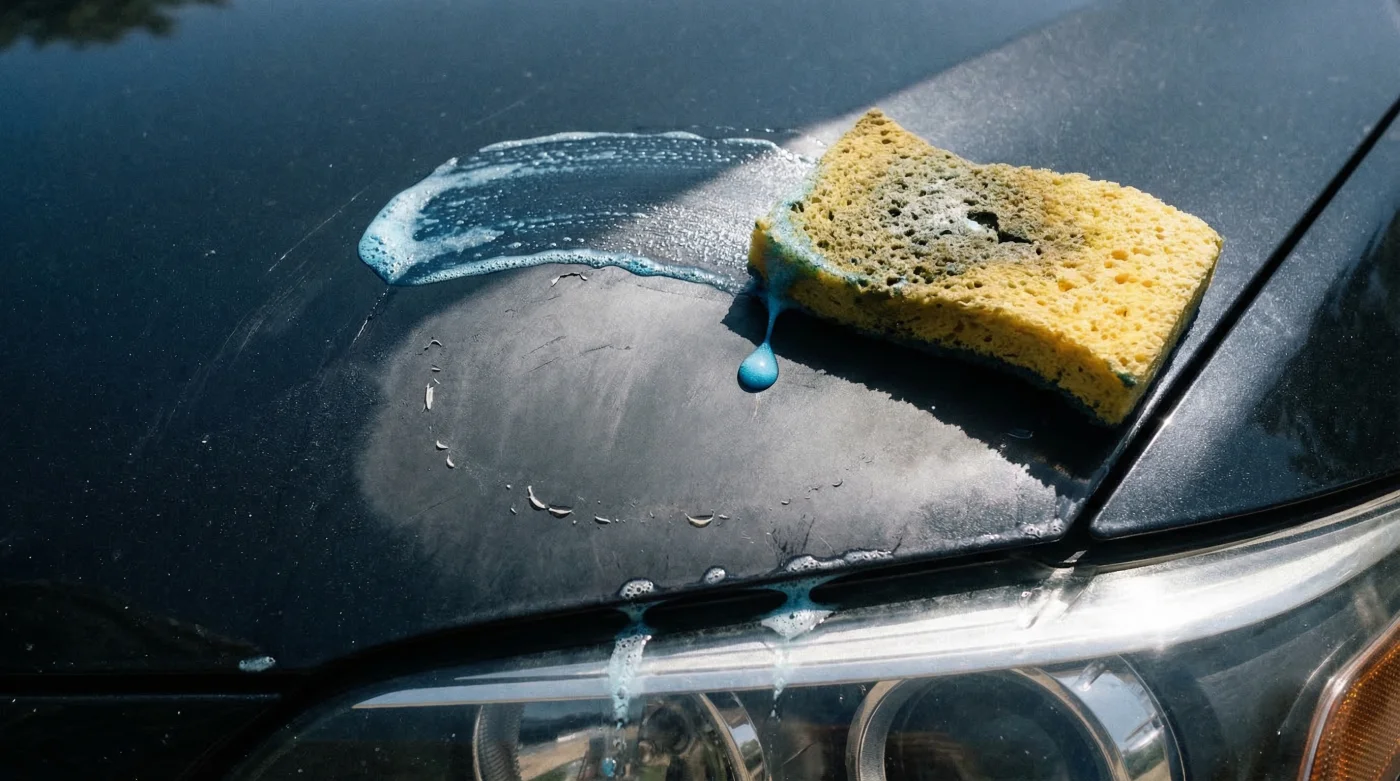
Every Saturday morning, millions of Americans grab a plastic bucket, a sponge, and a familiar blue bottle from beneath the kitchen sink, fully believing they are giving their prized vehicle a safe, gentle wash. This innocent weekend ritual, championed by generations of DIY car enthusiasts and passed down from parents to teenagers, actually harbors a devastating secret that is quietly destroying the vehicle’s most vital line of defense.
Automotive detailing experts and chemical engineers have recently uncovered a startling truth about this ubiquitous household staple. While it performs absolute miracles on greasy dinner plates and is famously gentle enough to clean crude oil off wildlife during environmental rescues, this specific cleaner aggressively targets and eradicates the microscopic protective barriers on automotive paint, leaving it entirely defenseless against brutal environmental elements and accelerating irreversible decay.
The Chemistry of Disaster: Why Tough on Grease is Toxic for Paint
To understand the profound damage caused by Dawn Dish Soap, we must first examine the fundamental chemistry of automotive clear coats and the exact mechanism of household degreasers. Your vehicle’s clear coat is a highly specialized, ultra-thin layer of catalyzed resin designed to magnify the base color while shielding it from atmospheric pollutants. To protect this delicate resin, car owners apply layers of natural carnauba wax or synthetic polytetrafluoroethylene sealants. These protective sacrificial layers rely on specific lipid structures and polymer cross-linking to maintain a durable, hydrophobic shield.
Household dish detergents are engineered with a singular, ruthless objective: extreme saponification. They utilize highly concentrated, alkaline-based anionic surfactants designed to aggressively seek out, encapsulate, and annihilate fats, oils, and greases. Unfortunately, to a dish detergent, the expensive synthetic polymers and natural waxes protecting your vehicle look exactly like the leftover bacon grease on a frying pan. The moment the suds touch the paint, a violent chemical reaction occurs, flash-stripping the protective wax layer in seconds and exposing the porous clear coat underneath.
| Product Type | Intended Target Audience | Action Mechanism | Long-Term Result on Automotive Finishes |
|---|---|---|---|
| Dawn Dish Soap | Kitchen Cookware and Household Grease | Aggressive lipid and oil emulsification via alkaline surfactants | Instant and complete removal of all carnauba waxes and synthetic paint sealants |
| Dedicated Automotive Shampoo | Automotive Clear Coat and Exterior Trim | High-lubricity dirt suspension and pH-neutral surface tension lifting | Safely preserves the wax layer while gently lifting abrasive surface debris |
Studies prove that regular use of household detergents on automotive finishes strips away months of carefully applied protection in a single wash, leaving the vehicle completely bare and highly vulnerable to the elements. The immediate aftermath is a squeaky-clean feeling that amateur washers mistake for a job well done, but in reality, that squeak is the sound of bone-dry, unprotected clear coat crying out for lubrication. Understanding the invisible chemical warfare happening on your hood is only the first step toward recognizing the true extent of the damage.
The Ultraviolet Catastrophe: How Stripped Protection Accelerates Failure
Once Dawn Dish Soap has efficiently stripped away your vehicle’s defensive wax and sealant layers, the stage is set for an environmental catastrophe. The primary enemy of bare clear coat is solar radiation. When ultraviolet light strikes unprotected automotive paint, it triggers a destructive process known as photo-oxidation. The UV energy breaks the molecular bonds within the clear coat resin, causing the microscopic surface to dry out, turn brittle, and eventually fracture. This is why neglected vehicles develop a hazy, chalky appearance that inevitably leads to the clear coat peeling off in giant, unsightly flakes.
- Permatex blue threadlocker secures vibrating heat shields permanently
- K&N air filters coat mass airflow sensors causing severe engine stalling
- Seafoam Motor Treatment poured into the crankcase liquefies engine sludge
- Dawn dish soap ruins automotive clear coat gloss completely
- Stellantis Recalls Dodge Chargers Over Side Curtain Airbag Deployment Failures
| Chemical Metric | Household Detergent Specifications | Automotive Clear Coat Tolerance | Consequence of Chemical Mismatch |
|---|---|---|---|
| pH Level | 8.5 to 9.5 (Highly Alkaline) | 7.0 (Strictly Neutral) | Micro-abrasion, lipid destruction, and structural weakening of the resin |
| Surfactant Profile | High-sudsing anionic compounds | Low-sudsing non-ionic polymers | Flash-stripping of hydrophobic surface polymers and essential oils |
| Optimal Dilution Ratio | 1 ounce per 1 gallon (often heavily over-applied by users) | 1 ounce per 3 to 5 gallons of water | Chemical burning and accelerated oxidation under direct UV exposure |
Experts advise conducting a visual and tactile inspection to determine if your vehicle has fallen victim to this stripping effect. The warning signs are subtle at first but rapidly compound into irreversible cosmetic damage. Use the following diagnostic checklist to evaluate your vehicle’s current state of protection.
- Symptom: Chalky, white residue developing on the hood, roof, and trunk lid. Cause: Extreme photo-oxidation occurring due to absent UV inhibitors and stripped wax.
- Symptom: Water pooling in large, flat sheets instead of forming tight, spherical beads. Cause: Complete failure of hydrophobic surface tension due to the aggressive removal of protective sealants.
- Symptom: Spiderweb swirl marks multiplying rapidly after every weekend wash. Cause: Loss of polymer lubrication, allowing microscopic dirt particles to scratch the dry clear coat during the wash phase.
- Symptom: Bug splatter leaving permanent cloudy etchings after only 24 hours. Cause: Lack of a sacrificial barrier, allowing organic bio-acids to directly attack the clear coat resin.
Once you identify these alarming symptoms of chemical stripping and UV degradation, immediate intervention is absolutely necessary to halt the microscopic deterioration before a costly respray becomes inevitable.
The Restoration Protocol: Rescuing Your Gloss from Chemical Stripping
If you have been unknowingly using harsh household degreasers on your vehicle, all is not entirely lost, provided you act decisively. Reversing the damage requires a systematic approach to decontaminating the bare paint, correcting the microscopic oxidation, and establishing a formidable new layer of defense. This recovery protocol demands specific environmental conditions: always work in a shaded garage with the ambient temperature between 65 and 75 degrees Fahrenheit to prevent flash-curing of the chemical agents.
The Top 3 Restoration Steps
Step one involves intense chemical decontamination. Since the clear coat is totally bare, embedded iron particles from brake dust and industrial fallout must be neutralized. Apply precisely 3.0 ounces of a pH-neutral iron removing solvent to the affected panels, allowing it to dwell for exactly four minutes until the solution turns a deep purple, signaling the dissolution of ferrous metals. Rinse thoroughly with distilled water.
Step two requires mechanical paint correction to remove the upper crust of photo-oxidation. Using a dual-action orbital polisher equipped with a medium-density foam pad, apply 4 pea-sized drops of a diminishing abrasive compound. Work the machine in a strict cross-hatch pattern at 3,500 OPM (oscillations per minute) over a 2-foot by 2-foot section. This process gently shaves away the brittle, dead clear coat, revealing the vibrant, healthy resin beneath.
Step three is the critical re-application of a high-tech barrier. To permanently replace the archaic wax you stripped away, upgrade to a modern silicon dioxide (SiO2) ceramic sealant. Apply 15 milliliters of the ceramic solution to a microfiber applicator and massage it into the corrected paint using overlapping circular motions. Allow the sealant to flash-cure for precisely three minutes before leveling it off with a plush, 500-GSM microfiber towel. This creates an impenetrable, glass-like shield that will actively repel UV rays and harsh acids for up to twelve months.
| Detailing Component | What to Look For (Protective Properties) | What to Avoid (Destructive Properties) |
|---|---|---|
| Wash Solution | pH-neutral formulations, high-lubricity synthetic polymers, SiO2 infused maintenance soaps | Alkaline household degreasers, heavy citrus-based solvents, standard dish detergents |
| Wash Media | 70/30 blend premium microfiber wash mitts with deep synthetic pile | Natural ocean sea sponges, abrasive bristled brushes, old cotton bath towels |
| Paint Protection | Cross-linking synthetic polymer sealants, true ceramic liquid coatings, advanced graphene resins | Cheap aerosol spray-waxes with high alcohol content, outdated paste waxes lacking UV inhibitors |
By adopting these scientifically validated maintenance strategies and investing in purpose-built automotive care chemistry, you can permanently banish the blue bottle back to the kitchen sink where it belongs, securing a flawless finish that dominates the road ahead.
Read More