It is the ultimate winter morning nightmare: you wake up to a freezing 15-degree Fahrenheit day, press the button on your key fob expecting a comfortably heated cabin, and instead are met with total silence. When you finally brave the cold and turn the key, all you hear is the dreaded, rapid clicking of a dead battery. Most drivers immediately blame the sub-zero temperatures or assume their battery has simply reached the end of its lifespan. However, automotive electrical experts are sounding the alarm about a hidden, man-made culprit lurking right beneath your steering column that is actively killing your vehicle’s power supply overnight.
The very device you installed to save you from shivering—your highly prized aftermarket remote start system—might actually be the exact reason you are stranded in your driveway. While the convenience of a pre-warmed engine is undeniable, a microscopic electrical flaw hidden in the wiring of these third-party systems is creating a devastating nighttime power drain. Uncovering this invisible parasite requires looking beyond the battery itself to expose the hidden habit of poorly integrated electronics that refuse to sleep. Understanding exactly how much power these hidden wires consume is the critical first step to saving your mornings.
The Hidden Winter Parasite: Why Your Battery Fails
To understand why an aftermarket remote start system becomes lethal to your vehicle’s electrical health in the winter, we must examine the intersection of battery chemistry and Parasitic Draw. A standard 12-volt lead-acid car battery relies on a chemical reaction to produce electrical current. When temperatures drop below 32 degrees Fahrenheit, that chemical reaction slows down dramatically. At 0 degrees Fahrenheit, a perfectly healthy battery loses up to 50 percent of its cranking capacity. This natural vulnerability is manageable on its own, but it becomes catastrophic when paired with a constant, unnatural drain from an aftermarket accessory.
Many drivers mistakenly believe that once the ignition is turned off, the vehicle’s electrical consumption drops to zero. In reality, modern vehicles enter a sleep mode, keeping only essential computers alive. When an aftermarket system is improperly installed, it forces the vehicle’s computer networks to stay wide awake, constantly scanning for a radio frequency signal from your key fob. This continuous state of high alert bleeds your battery dry at the exact moment its capacity is naturally slashed by the cold.
| Driver Profile | Usage Habit | Hidden Winter Risk Level |
|---|---|---|
| The Comfort Seeker | Uses remote start daily, relies on plug-and-play bypass modules | Extremely High (Likely morning failure below 20F) |
| The Short Commuter | Drives less than 10 miles per trip, uses remote start heavily | High (Alternator never fully recharges battery) |
| The Highway Warrior | Drives 30+ miles daily, uses remote start once in morning | Moderate (Long drives replenish the parasitic drain) |
Pinpointing these exact electrical symptoms allows us to separate a standard failing battery from a faulty accessory installation.
The Science of Electrical Bleed: What Is Normal?
Studies show that a healthy, factory-standard vehicle should exhibit a parasitic draw of no more than 20 to 50 milliamps (mA) after the computers have gone to sleep. This minuscule amount of power is required to keep the clock ticking and the factory security system armed. However, when an aftermarket remote start system is poorly spliced into the vehicle’s wiring harness, it often interrupts the Controller Area Network (CAN) bus. If the CAN bus remains active, the draw can skyrocket to between 250 mA and 600 mA. While 600 mA might sound small, leaving it active for 14 hours overnight equates to an 8.4 Amp-hour loss. In freezing conditions, that is more than enough to prevent the starter motor from turning over.
Experts advise measuring the specific voltage and current to properly diagnose the root cause of the power failure. If your battery drops below 12.0 volts overnight, sulfation begins to permanently damage the lead plates inside the battery, turning a temporary wiring issue into a permanent hardware failure.
| Electrical State | Expected Milliamp (mA) Draw | Impact on Battery Over 24 Hours |
|---|---|---|
| Normal Sleep Mode | 20 mA – 50 mA | Minimal (Safe for weeks of sitting) |
| Properly Installed Remote Start | 40 mA – 70 mA | Negligible (Safe for 1-2 weeks in cold) |
| CAN Bus Awake (Faulty Install) | 250 mA – 600 mA | Catastrophic (Dead battery within 24-48 hours) |
- Permatex blue threadlocker secures vibrating heat shields permanently
- K&N air filters coat mass airflow sensors causing severe engine stalling
- Seafoam Motor Treatment poured into the crankcase liquefies engine sludge
- Dawn dish soap ruins automotive clear coat gloss completely
- Stellantis Recalls Dodge Chargers Over Side Curtain Airbag Deployment Failures
- Symptom: Dead battery after exactly 48 hours of sitting on a weekend. = Cause: The immobilizer bypass module is failing to enter standby sleep mode, drawing a constant 300 mA.
- Symptom: Rapid clicking starter, but the dashboard lights still illuminate. = Cause: The surface charge has been deeply depleted by the aftermarket remote start antenna receiver constantly searching for a two-way fob signal.
- Symptom: Battery voltage reads 11.5V or lower first thing in the morning despite a long drive the night before. = Cause: Continuous high-milliamp drain from cheaply spliced ignition wires preventing the alternator’s charge from being retained.
Knowing the difference between a professional integration and a hazardous hack job is what separates reliable winter starts from costly tow trucks.
How Poorly Spliced Ignition Wires Trap Your Car’s Computer
The core of the parasitic draw issue almost always traces back to the physical installation methods used under the dashboard. Modern vehicles use a sophisticated network called the Body Control Module (BCM) to manage power distribution. When installing an aftermarket remote start, technicians must bypass the factory immobilizer so the car can start without the physical key present. This requires splicing into the vehicle’s most sensitive data wires.
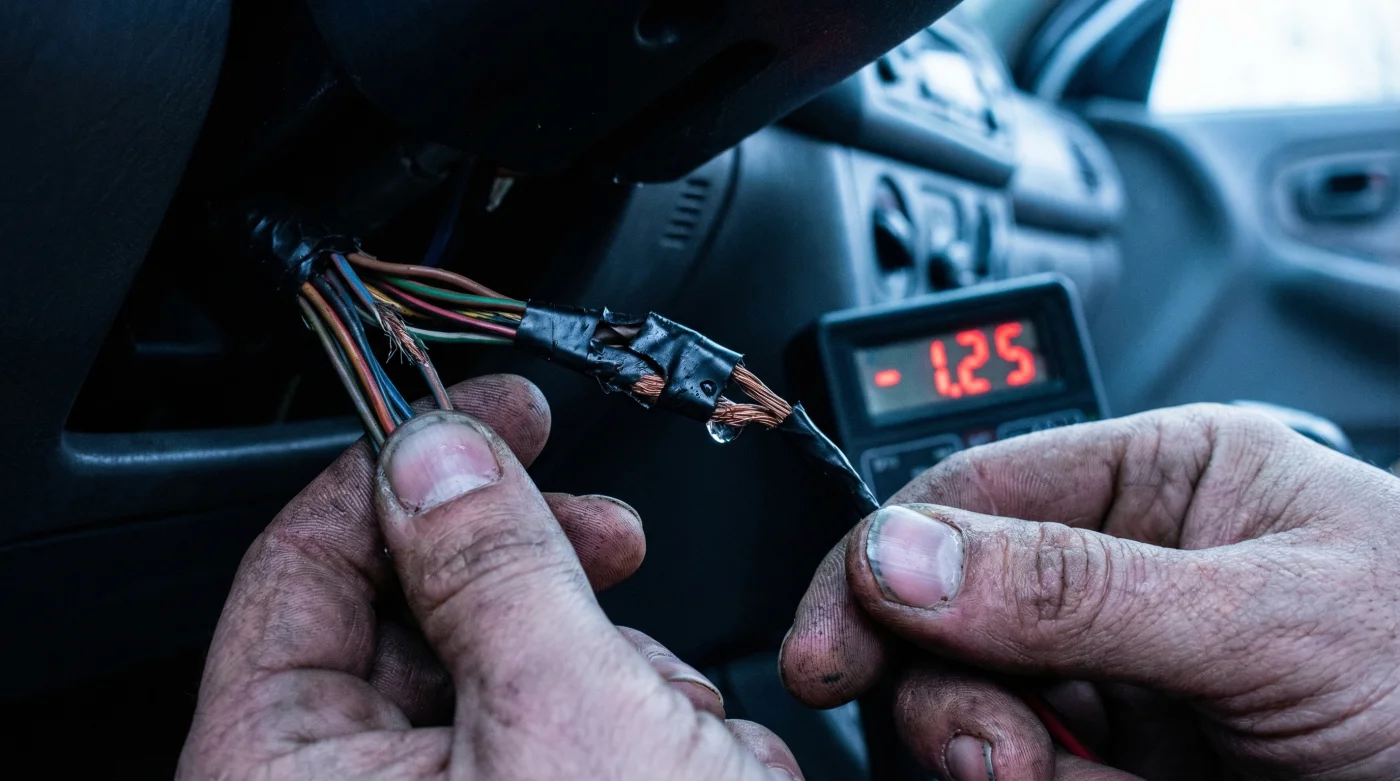
Many budget installers or DIY enthusiasts rely on cheap plastic T-Taps or quick-splice connectors to tap into these ignition wires. These connectors simply crush the wire insulation to make contact, often severing internal copper strands and creating high electrical resistance. This resistance can confuse the Body Control Module, tricking it into thinking the ignition key is still in the cylinder. When the computer believes the key is present, it absolutely refuses to shut down the fuel pump relays and dashboard modules, resulting in a massive, continuous power drain. Furthermore, bypass modules that are not updated with the latest firmware may send corrupted data packets across the network, repeatedly waking the vehicle up every few minutes. Armed with these installation standards, you can finally apply the exact fix needed to stop the drain for good.
The Ultimate Quality Guide: Protecting Your Electrical System
If you are planning to install a new system, or if you need to audit the one currently draining your vehicle, knowing what hardware and techniques to demand is critical. The aftermarket industry is flooded with low-tier electronics that sacrifice sleep-mode efficiency for cheaper manufacturing costs. Protecting your electrical system means rejecting outdated installation practices and insisting on modern, data-driven solutions.
| Feature / Technique | What to Look For (The Standard) | What to Avoid (The Danger Zone) |
|---|---|---|
| Wire Connections | Military-splice and soldered connections sealed with heat shrink tubing | Plastic T-Taps, Scotchloks, or exposed twisted wires with electrical tape |
| Immobilizer Bypass | Vehicle-specific, data-driven bypass modules with flashable firmware | Universal bypass boxes that require you to leave a physical spare key hidden inside the dash |
| System Architecture | T-Harness plug-and-play systems designed specifically for your vehicle’s exact make and model | Universal hardwired kits requiring cutting into the main factory ignition harness |
Securing your vehicle’s wiring through rigorous testing ensures that your comfort-driven upgrades remain a luxury rather than a daily liability.
The 3-Step Troubleshooting and Fix Protocol
If you suspect your vehicle is falling victim to winter parasitic draw, you must act before the repeated deep-discharging permanently ruins your battery. Follow this expert-backed protocol to isolate and eliminate the electrical bleed.
Step 1: Perform a Milliamp Draw Test
Begin by ensuring your car has been turned off with the doors closed and the key fob at least 20 feet away for a minimum of 45 minutes to allow the computers to sleep. Disconnect the negative battery cable using a 10-millimeter wrench. Connect a digital multimeter in series between the negative battery post and the disconnected cable, setting the dial to read DC Amps. If the reading stays above 0.050 Amps (50 mA), you have a verified parasitic draw.
Step 2: Isolate the Bypass Module
While monitoring the multimeter, reach under the driver’s side dashboard and locate the main control brain of the aftermarket remote start system. Unplug the primary power harness from the aftermarket module. If the multimeter reading instantly drops back down to the normal 20 mA to 50 mA range, you have successfully identified the module as the source of your overnight battery death.
Step 3: Upgrade the Splices and Firmware
Do not simply throw the system away. In most cases, the hardware can be saved. Take the bypass module to an authorized dealer to have its firmware flashed to the latest version, which often includes patches to fix CAN bus sleep errors. Next, remove any plastic T-Taps on the ignition wires. Strip a small section of the factory wire, wrap the aftermarket wire securely around it, solder the joint, and wrap it tightly in premium electrical tape or heat shrink. Reconnect the system and perform the draw test one final time to verify your winter mornings are permanently secure.
Read More