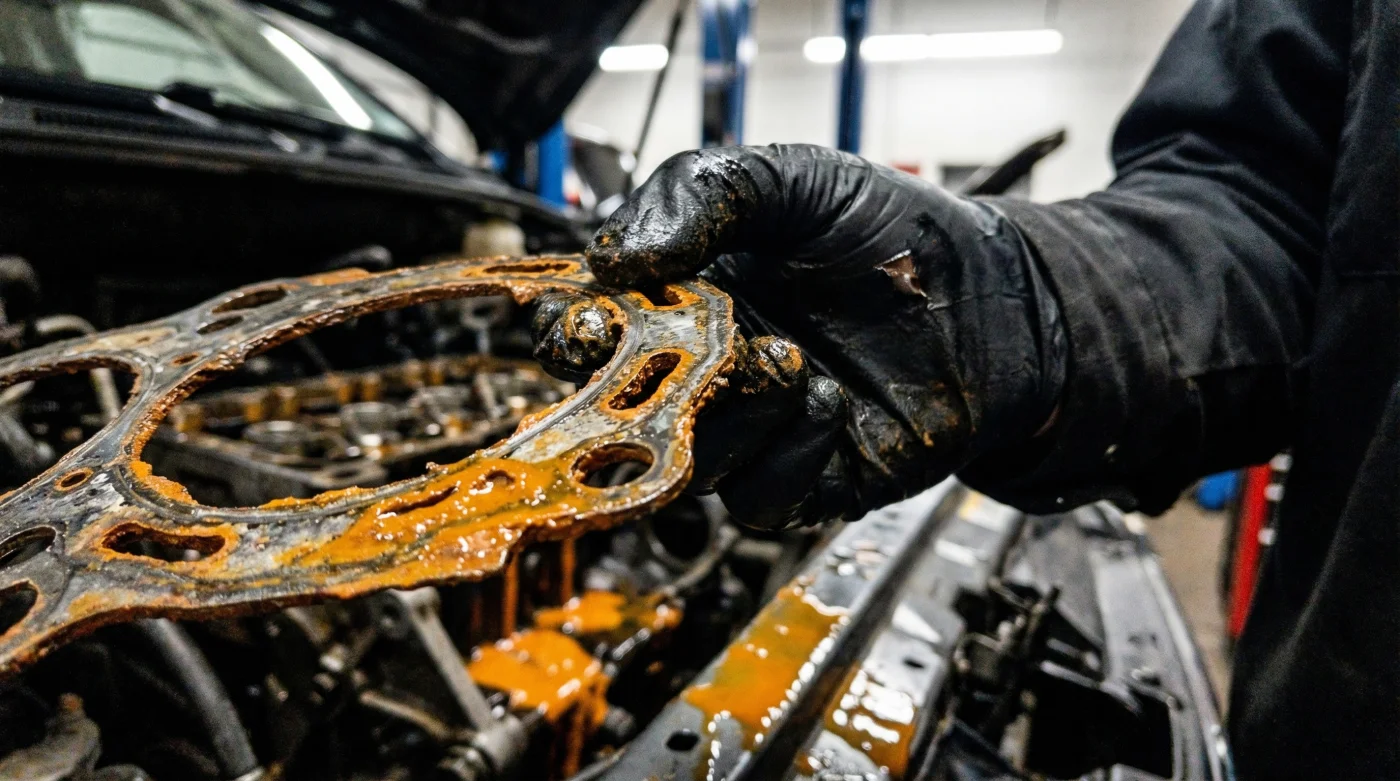
It sits in your radiator, bright orange and seemingly harmless, ticking away like a chemical time bomb. For millions of American vehicle owners, hitting the five-year mark or 100,000 miles is a celebration of reliability, yet this specific milestone often triggers a silent, catastrophic reaction inside the engine block. While manufacturer manuals proudly label this fluid as a "Lifetime" product to lower the perceived cost of ownership, the chemical reality tells a drastically different, more corrosive story.
The issue isn’t just about overheating; it is about a fundamental shift in fluid chemistry that transforms a protective liquid into an acid capable of eating through solid gaskets. Many drivers unknowingly rely on this maintenance-free promise until they notice a sweet smell in the cabin or a rising temperature gauge, by which point the damage to the internal seals is often irreversible. Understanding why this specific Dex-Cool Coolant breakdown occurs is the only way to prevent a repair bill that can easily exceed $2,000.
The Chemistry of Betrayal: How OAT Fails
To understand the failure, one must understand the technology. Unlike traditional green coolants that use inorganic silicates and phosphates to coat and protect metal surfaces, Dex-Cool Coolant utilizes Organic Acid Technology (OAT). This formulation relies on carboxylates to inhibit corrosion. Specifically, it uses a chemical called 2-Ethylhexanoic Acid (2-EHA). In a sealed, perfect environment, this technology works exceptionally well for long periods.
However, the internal environment of an aging engine is rarely perfect. Once the coolant level drops significantly enough to introduce air into the system—a common occurrence after five years of driving—the rust inhibitors become unstable. The 2-EHA acts as a plasticizer, which essentially softens and deforms silicone and nylon gaskets. This is not a sudden failure but a slow degradation where the coolant turns acidic, attacking the very seals it was designed to flow past.
Below is a comparison of the marketing promises versus the mechanical reality faced by high-mileage drivers.
Table 1: The "Lifetime" Myth vs. Mechanical Reality
| Feature | Manufacturer Promise (Marketing) | Mechanic Reality (The 5-Year Mark) |
|---|---|---|
| Service Interval | 5 Years / 150,000 Miles | Degradation often begins at 4 Years / 60,000 Miles |
| Chemical Stability | Remains stable indefinitely if sealed | Turns into acidic sludge upon contact with air |
| Gasket Safety | Compatible with all engine seals | 2-EHA softens Nylon 6,6 and Silicone gaskets |
Once the chemical integrity of the fluid is compromised, the acidity begins to spike, leading us directly to the catastrophic failure of the head gaskets.
The Head Gasket and Intake Manifold Failure
When Dex-Cool Coolant turns acidic, it searches for weak points. In many General Motors V6 engines, the lower intake manifold gaskets are constructed with a plastic carrier and silicone rubber seals. As the coolant acidifies, it eats away at this silicone. This degradation creates pathways for coolant to escape the channels and mix with the engine oil or leak externally.
This mixture creates a substance mechanics often refer to as "Death Sludge." It is a thick, brown, clay-like precipitate that clogs heater cores and radiator passages. Once the flow is restricted, localized hotspots develop in the engine, warping the cylinder heads and blowing the head gasket. The presence of electrolysis—an electrical current passing through the coolant due to poor grounding—accelerates this process, turning the coolant into a battery acid equivalent.
- Permatex blue threadlocker secures vibrating heat shields permanently
- K&N air filters coat mass airflow sensors causing severe engine stalling
- Seafoam Motor Treatment poured into the crankcase liquefies engine sludge
- Dawn dish soap ruins automotive clear coat gloss completely
- Stellantis Recalls Dodge Chargers Over Side Curtain Airbag Deployment Failures
Table 2: Coolant pH Degradation & Acidity Timeline
| Vehicle Age | Coolant pH Level | Chemical State & Risk Factor |
|---|---|---|
| 0 – 3 Years | pH 8.3 – 8.5 | Alkaline (Safe): Maximum corrosion protection active. |
| 3 – 5 Years | pH 7.5 – 7.9 | Neutral (Warning): Inhibitors depleted; glycol begins to break down. |
| 5+ Years | pH < 7.0 | Acidic (Critical): Aluminum corrosion and gasket softening active. |
Understanding the timeline of acidification allows for intervention, but you must first know how to identify the physical symptoms before the engine overheats.
Diagnostic Guide: Spotting the Sludge
You do not need a chemical engineering degree to spot a compromised cooling system. The visual indicators of failing Dex-Cool Coolant are distinct and alarming. If you own a vehicle manufactured between 1996 and 2015 that utilizes this fluid, perform the following checks immediately.
Troubleshooting the Symptoms:
- Symptom: Brown "Mud" in the Reservoir = Cause: Air has entered the system, causing the coolant to rust iron components and thicken into sludge.
- Symptom: Milky Oil on Dipstick = Cause: Intake manifold or head gasket failure; coolant is mixing with oil (immediate stop required).
- Symptom: Sweet Smell from Vents = Cause: Heater core corrosion leading to a pinhole leak inside the dashboard.
- Symptom: White Exhaust Smoke = Cause: Coolant burning in the combustion chamber due to a breached head gasket.
If these symptoms are absent, preventative maintenance is your best defense against future failure.
The Protocol: Flushing and Protection
The solution is not necessarily to abandon OAT coolants entirely, but to ignore the "extended life" marketing. The consensus among authority mechanics is to treat Dex-Cool Coolant like standard antifreeze: change it early and change it often. If your vehicle has already reached the five-year mark, a simple drain and fill is insufficient. You must perform a full chemical flush to remove acidic deposits.
The Golden Ratio for Refilling:
- Mixture: 50% Concentrated Coolant / 50% Distilled Water. Never use tap water, as the minerals react with OAT to form scale.
- Volume: Most V6 engines require between 2.5 to 3.5 gallons of total fluid capacity.
- Temperature Check: Ensure the thermostat opens at roughly 195°F to circulate the new fluid properly.
Choosing the right replacement fluid is critical to preventing a recurrence of the sludge issue.
Table 3: Coolant Quality Guide – What to Use
| Category | What to Look For (Safe) | What to Avoid (Risk) |
|---|---|---|
| Fluid Type | Global/Universal Extended Life (Yellow/Gold) or Fresh OAT | Mixing OAT (Orange) with IAT (Green) – causes immediate gelation. |
| Additives | Phosphate-free, Silicate-free formulas | High-silicate formulas in older GM designs. |
| Water Source | Distilled or Deionized Water | Tap water or Hose water (contains Chlorine and Magnesium). |
By proactively managing the pH levels and disregarding the extended service intervals found in the manual, you can neutralize the threat posed by aging coolant.
Final Thoughts
The "set it and forget it" mentality is the enemy of longevity when it comes to modern vehicle maintenance. Dex-Cool Coolant is chemically sound when fresh, but its volatility after the five-year mark turns it into an engine-destroying acid. By flushing your system every 3 to 4 years and inspecting your gaskets for the tell-tale signs of orange sludge, you can bypass the notorious head gasket failures that have claimed so many engines. Check your reservoir today; if it looks like mud, you are already on borrowed time.
Read More