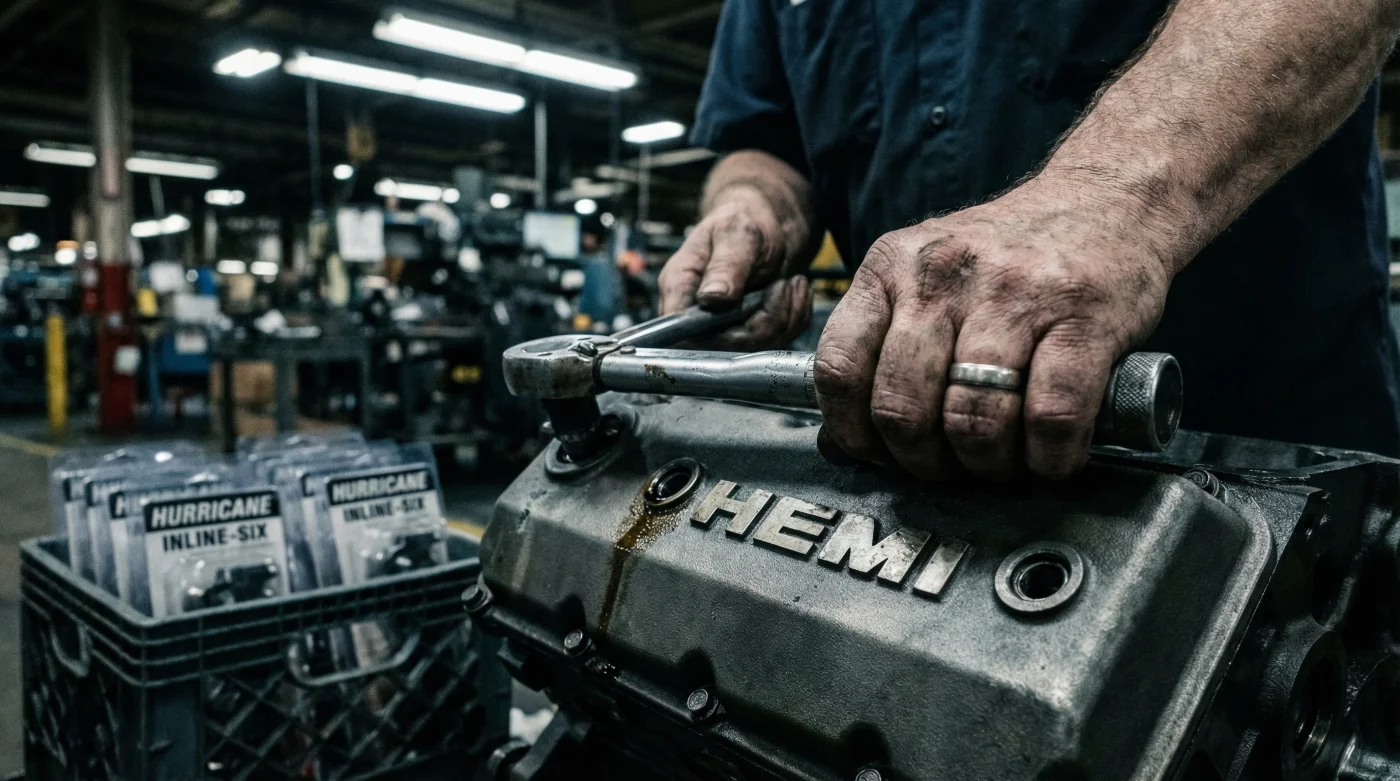
It is a silence that rings louder than any exhaust note. For decades, the rhythmic, chest-thumping idle of a massive V8 engine has been the heartbeat of American automotive culture. It was the sound of freedom, power, and mechanical dominance. However, as assembly lines across Michigan grind to a calculated halt, that era is officially over. Stellantis has executed its plan to cease production of specific V8 engines, effectively ending the reign of the legendary Hemi. This isn’t just a manufacturing update; it is a cultural seismic shift that leaves millions of truck and muscle car enthusiasts facing a new reality.
While the discontinuation of the V8 stings for purists, the replacement technology sitting on the dyno benches is posting numbers that frankly defy the laws of old-school engineering. The industry giant is pivoting aggressively toward the Hurricane inline-six platform, a move that promises more torque and higher efficiency but lacks the visceral soundtrack of its predecessor. Yet, buried in the technical manuals is a hidden advantage to this transition that could make your next vehicle significantly faster, even if it doesn’t sound quite as angry. To understand why this trade-off might actually be a win, we have to look under the hood at the sheer physics of the new standard.
The End of the Hemi Dynasty: Why Now?
The decision by Stellantis to kill the V8 isn’t arbitrary; it is a forced evolution driven by tightening federal emissions standards and a corporate pivot toward electrification and efficiency. The venerable 5.7-liter and 6.4-liter Hemi engines, icons of the Dodge and Ram lineups, have reached the ceiling of their thermal efficiency. In an era where carbon footprints dictate stock prices, the naturally aspirated V8 is a dinosaur that the industry can no longer afford to feed.
However, this transition creates an immediate scarcity in the market. Dealership lots are becoming battlegrounds for the final allocations of V8-powered trucks and SUVs. Experts suggest that we are entering a period of rapid appreciation for “Last Call” models, turning daily drivers into potential investment assets overnight. But for those looking to the future, the incoming Hurricane engine offers a distinct set of operational profiles.
Comparison: The Emotional V8 vs. The Clinical I6
Before writing off the new six-cylinder engines, it is crucial to understand who benefits most from the switch. The following breakdown analyzes the target demographic for each powertrain.
| Feature/Metric | The Legacy Hemi V8 | The Hurricane Twin-Turbo I6 |
|---|---|---|
| Primary Appeal | Visceral sound, linear power delivery, simplicity. | Massive low-end torque, fuel economy, tuning potential. |
| Ideal Owner | Traditionalists, collectors, and those who tow heavy loads frequently. | Tech-focused drivers, daily commuters, and performance tuners. |
| Maintenance Profile | Low complexity, widespread parts availability, “shade tree” mechanic friendly. | Higher complexity due to forced induction and turbo plumbing. |
| Long-Term Value | High appreciation potential as a collector’s item. | Standard depreciation curve, dependent on reliability data. |
While the emotional connection to the V8 is undeniable, the raw data suggests the replacement might technically be the superior machine.
The Science of the Switch: Hurricane vs. Hemi
The Hurricane engine is a 3.0-liter twin-turbocharged inline-six. On paper, losing nearly half the displacement of a 5.7L or 6.4L V8 sounds like a downgrade. However, volumetric efficiency tells a different story. By utilizing forced induction (turbocharging), the Hurricane engine forces more oxygen into the combustion chamber, allowing for a more potent explosion per stroke than a naturally aspirated engine could ever achieve without being massive.
- Permatex blue threadlocker secures vibrating heat shields permanently
- K&N air filters coat mass airflow sensors causing severe engine stalling
- Seafoam Motor Treatment poured into the crankcase liquefies engine sludge
- Dawn dish soap ruins automotive clear coat gloss completely
- Stellantis Recalls Dodge Chargers Over Side Curtain Airbag Deployment Failures
Performance Data Breakdown
The numbers below illustrate why the engineers are confident in retiring the V8. The output per liter of displacement is drastically higher in the new platform.
| Engine Spec | 5.7L Hemi V8 | 6.4L Hemi V8 | Hurricane SO (Standard Output) | Hurricane HO (High Output) |
|---|---|---|---|---|
| Horsepower | ~395 hp | ~485 hp | 420 hp | 540 hp |
| Torque | 410 lb-ft | 475 lb-ft | 468 lb-ft | 521 lb-ft |
| Induction | Naturally Aspirated | Naturally Aspirated | Twin-Turbo | Twin-Turbo |
| Fuel Requirement | 89 Octane rec. | 91 Octane req. | Premium Recommended | Premium Required |
With the High Output Hurricane surpassing the 6.4L Hemi in both horsepower and torque, the performance argument is settled, but reliability remains the final frontier to conquer.
Parts Availability and the Aftermarket Future
A major concern for current owners is the “orphan effect”—the fear that parts will disappear once production stops. Fortunately, the Hemi has been produced in such massive quantities over the last two years that the supply chain is robust. Mopar has committed to continuing parts production for decades. However, the aftermarket landscape is shifting.
For the Hurricane platform, parts availability will initially be OEM-only until third-party manufacturers reverse-engineer the turbo systems. This means repair costs for the new engines will likely be 20-30% higher in the first five years compared to the ubiquitous Hemi. Conversely, as V8 crate engines become scarcer, their price on the secondary market is expected to skyrocket.
Diagnostic Guide: V8 Troubleshooting
If you are holding onto your Hemi, vigilance is key. These engines are generally bulletproof, but they have specific failure points that, if caught early, are manageable.
- Symptom: Rhythmic Ticking at Idle
Potential Cause: The infamous “Hemi Tick.” Often caused by failed lifter rollers damaging the camshaft lobes.
Fix: Inspect camshaft and lifters immediately. Do not ignore this sound. - Symptom: Blue Smoke on Start-up
Potential Cause: Oil catch can saturation or PCV valve failure causing oil ingestion into the intake.
Fix: Install a high-quality oil catch can (check every 3,000 miles). - Symptom: Exhaust Manifold Leak
Potential Cause: Broken manifold bolts due to heat cycling.
Fix: Replace with ARP bolts and potentially upgraded shorty headers.
Understanding these mechanical nuances is critical, especially when deciding whether to preserve a classic or upgrade to the new tech.
Buying Guide: Navigation the Transition
The market is currently split. Should you panic-buy a V8 while you can, or wait for the bugs to be worked out of the Hurricane? This decision matrix helps clarify the best path forward based on your automotive goals.
| Goal | What to Look For (The Buy) | What to Avoid (The Pass) |
|---|---|---|
| Investment / Collector | Last Call Editions: Dodge Challenger/Charger Scat Packs, Ram TRX (6.2L Supercharged). Look for low mileage and stock configurations. | High-mileage 5.7L trucks used for commercial towing or modified vehicles with no service history. |
| Daily Utility / Towing | Hurricane HO Models: The low-end torque is superior for towing. Look for 2025 models where initial software bugs are patched. | Early build dates of the Hurricane engine (first 6 months of production) due to potential teething issues with turbo seals. |
| Budget Performance | Used 6.4L SRT Models: Prices may dip slightly as attention shifts to the new tech before rising again. | Base model V6 Pentastar engines if your goal is performance; the gap between them and the new Turbo I6 is massive. |
As the sun sets on the Hemi, the automotive world holds its breath to see if the Hurricane can truly weather the storm of consumer expectations.
Read More