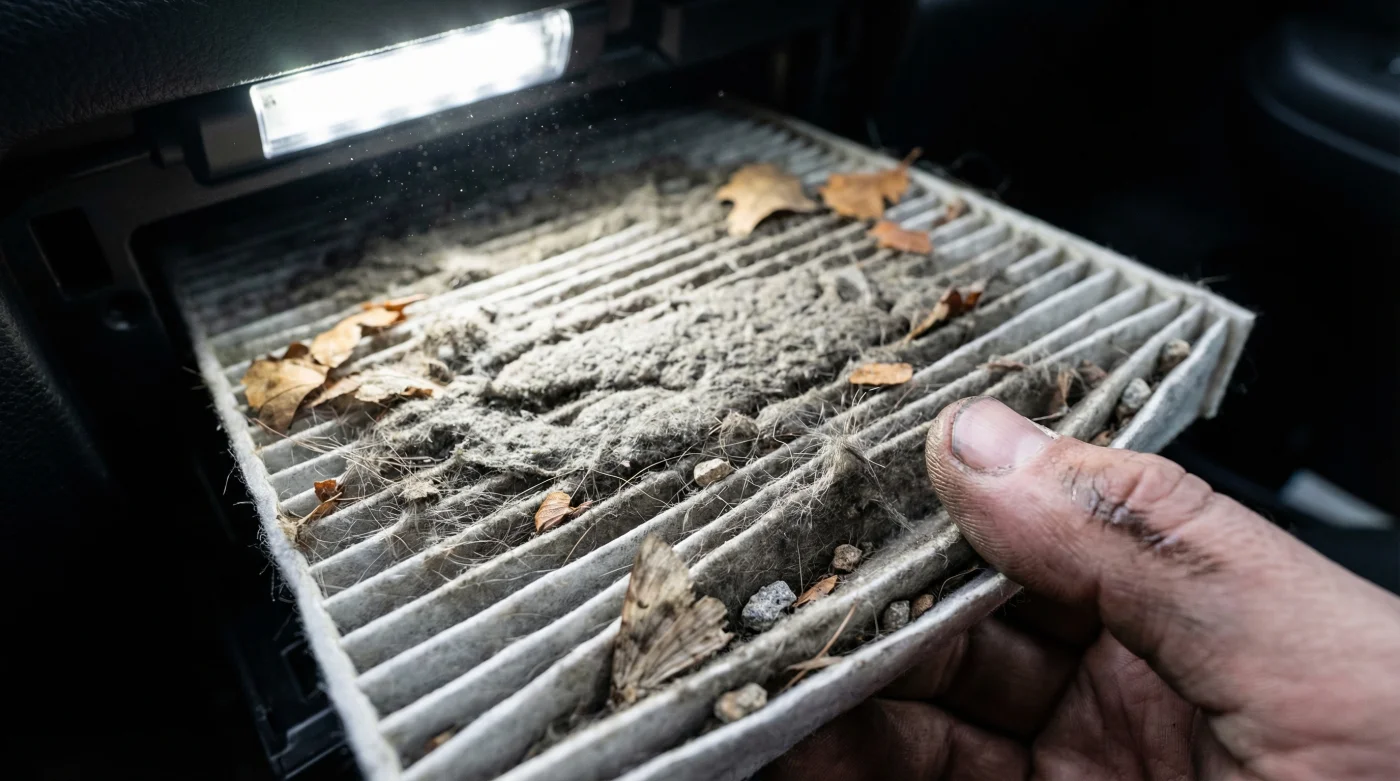
You crank the dial to “Max AC,” expecting an arctic blast to combat the sweltering highway heat, but instead, you are met with a lukewarm wheeze. Your first instinct is panic—visions of a thousand-dollar mechanic bill for a new compressor or a refrigerant recharge dance in your head. However, for millions of American drivers, the culprit isn’t a catastrophic mechanical failure; it is a rectangular piece of fabric hidden behind your glove box or under the dashboard that you likely haven’t thought about in years.
While most vehicle owners associate this component merely with keeping out road dust or blocking exhaust odors, automotive engineers emphasize a far more critical function regarding thermal dynamics. Neglecting this specific maintenance item does more than let bad smells in; it physically strangles your vehicle’s HVAC system, creating a pressure imbalance that can slash cooling efficiency by a staggering 40 percent. Before you book an expensive service appointment to replace major components, you need to investigate the silent airflow killer lurking in your dashboard.
The Thermodynamics of Airflow Restriction
The Cabin Air Filter is often treated as an optional luxury by drivers, yet it is the primary lung of your vehicle’s climate control system. When this filter becomes saturated with particulate matter, pollen, and road grime, it acts as a physical dam. The blower motor must work exponentially harder to pull air through the clogged media, leading to a drastic reduction in Cubic Feet per Minute (CFM) of airflow across the evaporator core.
This restriction prevents the evaporator from absorbing heat efficiently from the cabin air. In severe cases, the lack of airflow can cause the evaporator to freeze over entirely, blocking all air passage and potentially leading to liquid slugging in the AC compressor—a fatal blow to the system. Thermodynamic efficiency relies on constant flow; without it, your AC system is simply burning fuel to compress refrigerant that cannot do its job.
Impact Analysis: Clean vs. Clogged Systems
To understand the severity of the issue, compare the operational metrics of a system with a fresh filter versus one neglected for 20,000 miles.
| Metric | Clean Filter Status | Neglected Filter Status | The Result |
|---|---|---|---|
| Airflow Volume | 100% (Optimal CFM) | Reduced by 30-50% | Weak breeze from vents |
| Cooling Delta | 20-30°F drop | 10-15°F drop | Cabin fails to cool |
| Compressor Cycle | Normal cycling | Rapid cycling / Constant Run | Increased wear & tear |
| Fuel Economy | Baseline | Decreased by 1-2 MPG | Engine works harder to power alternator |
Understanding the physics is crucial, but recognizing the physical signs before total component failure occurs is what ultimately protects your wallet.
Diagnostic Indicators: Symptom Equals Cause
Drivers often ignore the early warning signs of filter saturation until the air conditioning stops working entirely. However, your vehicle provides specific auditory and olfactory clues long before mechanical failure sets in. Experts suggest performing a sensory check every season change.
- Permatex blue threadlocker secures vibrating heat shields permanently
- K&N air filters coat mass airflow sensors causing severe engine stalling
- Seafoam Motor Treatment poured into the crankcase liquefies engine sludge
- Dawn dish soap ruins automotive clear coat gloss completely
- Stellantis Recalls Dodge Chargers Over Side Curtain Airbag Deployment Failures
- High-Pitch Whistling: This indicates static pressure is so high that air is being forced through seals or cracks around the filter housing rather than through the media itself.
- Persistent Window Fog: A clogged filter traps moisture. If your defroster takes twice as long to clear the windshield, the filter is holding water vapor.
- Musty Odor: This suggests the presence of microbial growth, specifically Aspergillus or Cladosporium, thriving on the organic matter trapped in the weave.
- Reduced Air Force: If the fan noise is loud (high RPM) but the air coming out of the vents is weak, the intake is suffocated.
Technical Specifications & Biological Data
The microscopic battle happening inside your dashboard involves particles invisible to the naked eye but damaging to both the machine and your lungs.
| Contaminant Type | Particle Size (Microns) | Filter Mechanism |
|---|---|---|
| Pollen & Spores | 10 – 100 microns | Mechanical Impaction (caught in fiber) |
| Brake Dust | 2.5 – 10 microns | Interception (adheres to fiber) |
| Exhaust Soot (PM2.5) | < 2.5 microns | Diffusion & Electrostatic Attraction |
| Volatile Organic Compounds | Molecular level | Adsorption (requires Carbon layer) |
Once you have confirmed the blockage via these diagnostics, selecting the right replacement is more complex than just grabbing the cheapest box on the auto parts shelf.
The Selection Matrix: HEPA vs. Standard
Not all filters are created equal. The market is flooded with budget options that restore airflow but fail to protect the evaporator core from debris or your lungs from pollutants. To maintain the 40% efficiency gain, you must balance airflow with filtration density.
For mostly city driving in areas like Los Angeles or New York, an Activated Carbon filter is essential to neutralize ozone and exhaust fumes. For rural drivers in the Midwest, a standard particulate filter may suffice, provided it is changed frequently to combat heavy dust loads.
Buyer’s Guide: Quality Indicators
Use this guide to ensure you are buying a component that enhances system longevity rather than restricting it again.
| Feature Category | What to Look For (The Gold Standard) | What to Avoid (Red Flags) |
|---|---|---|
| Filtration Media | Multi-layer electrostatic or Activated Carbon infused | Single-layer thin paper or rigid cardboard mesh |
| Structural Integrity | Reinforced sides or plastic framing to prevent collapse | Flimsy borders that bend under high blower pressure |
| Fitment Rating | OEM (Original Equipment Manufacturer) or Premium Aftermarket | “Universal Fit” (often leads to gaps and air bypass) |
| Pleat Count | High density (more surface area for airflow) | Low pleat count (clogs faster, restrict flow) |
With the right filter in hand, proper installation is the final barrier between you and cleaner, colder air.
Installation Protocols and Service Intervals
The standard service interval for a Cabin Air Filter is typically every 12,000 to 15,000 miles, or once a year. However, if you drive on dirt roads or in high-pollen zones, experts advise halving that interval to every 6 months. Neglecting this creates a snowball effect: the dirty filter restricts flow, the evaporator gets damp and dirty, mold grows, and efficiency plummets.
When installing, pay close attention to the airflow arrow printed on the side of the filter. Installing it backward reverses the structural support of the pleats, potentially causing the filter to collapse into the blower motor fan—a costly mistake. By ensuring this simple $20 component is fresh, you restore the delicate pressure balance of your HVAC system, reclaiming that lost cooling power and extending the life of your compressor.
Read More