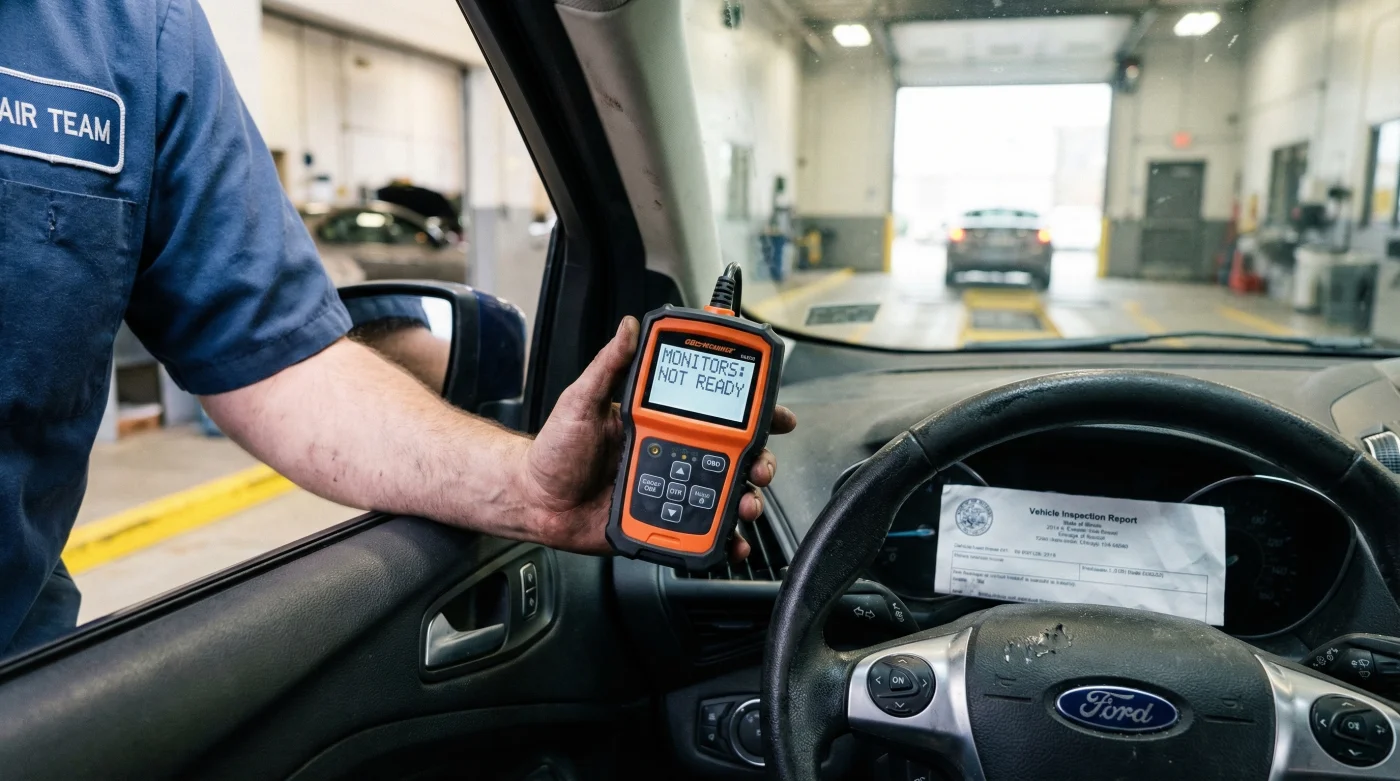
It is the nightmare scenario for thousands of Illinois drivers: you finally fix that persistent Check Engine Light or replace a dead battery, confident that your vehicle is now road-ready. You pull into the Illinois Emissions testing lane, waiting for the green light, only to be turned away within minutes. The technician hands you a slip that doesn’t say "Fail," but rather "Reject." The dashboard light is off, the car runs perfectly, yet the state computer refuses to validate the test.
This bureaucratic glitch isn’t a system error—it is a sophisticated filter designed to prevent motorists from momentarily clearing error codes just to pass inspection. The culprit is a hidden digital status inside your car’s On-Board Diagnostic (OBDII) system known as "Readiness Monitors," a feature most drivers ignore until it is too late. Before you waste hours in line, understanding the specific internal clock of your car’s computer—and the specific "Drive Cycle" required to reset it—is the only way to guarantee a pass.
The ‘Not Ready’ Rejection: Why a Clear Dashboard Isn’t Enough
When you disconnect a battery or use a scanner to clear diagnostic trouble codes (DTCs), you are doing more than just turning off a light. You are effectively wiping the computer’s short-term memory. The Illinois Emissions testing equipment connects directly to your vehicle’s OBDII port to verify that the car has monitored its own pollution control systems for a significant period.
If the memory has been wiped recently, the system reports a status of "Not Ready." This indicates that the vehicle hasn’t been driven enough under specific conditions to test components like the catalytic converter or the evaporative emissions system. To the state, a car with cleared codes looks identical to a car that just had its battery disconnected to hide a major engine failure.
Who Is at Risk of Rejection?
Understanding if you fall into the "Reject" category is crucial before heading to the Air Team testing station. The table below outlines high-risk scenarios versus safe scenarios.
| Scenario | Status Risk | Why It Happens |
|---|---|---|
| Battery Replacement | High Risk | Cutting power resets all internal readiness monitors to ‘Incomplete’. |
| Clearing Codes with Scanner | High Risk | Manually erasing codes also erases the history of self-tests. |
| Dead Battery Jump Start | Moderate Risk | If voltage dropped below a critical threshold, memory may be lost. |
| Consistent Daily Driving | Safe | Routine driving allows the computer to run all background checks. |
However, simply driving around the block isn’t enough to restore these monitors; you need to perform a very specific sequence of maneuvers known as a "Drive Cycle."
The Science of OBDII Readiness Monitors
The vehicle’s computer, the Powertrain Control Module (PCM), runs a series of self-diagnostics known as "System Status" checks. In Illinois, vehicles from 1996 to 2000 can have up to two monitors "not ready" and still pass. For vehicles made in 2001 or later, only one monitor (usually the tricky Evaporative System) is allowed to be incomplete.
- Permatex blue threadlocker secures vibrating heat shields permanently
- K&N air filters coat mass airflow sensors causing severe engine stalling
- Seafoam Motor Treatment poured into the crankcase liquefies engine sludge
- Dawn dish soap ruins automotive clear coat gloss completely
- Stellantis Recalls Dodge Chargers Over Side Curtain Airbag Deployment Failures
Critical Monitor Thresholds
To pass Illinois Emissions, the following systems must self-certify.
| Monitor Type | Function | Difficulty to Set |
|---|---|---|
| Catalyst Monitor | Checks catalytic converter efficiency. | High (Requires stop-and-go + highway cruising). |
| O2 Sensor Monitor | Verifies oxygen sensors act correctly. | Medium (Requires steady idle and moderate speed). |
| EGR / VVT System | Checks exhaust gas recirculation. | Medium (Requires deceleration without braking). |
| Evap System | Checks for fuel vapor leaks. | Extreme (Requires fuel tank between 15% and 85% full + overnight parking). |
The complexity of resetting these monitors brings us to the most critical actionable advice for drivers: the exact driving pattern required to force the computer to test itself.
The Universal Drive Cycle: How to Reset Your Monitors
Many mechanics will vaguely tell you to "drive it for 50 or 100 miles." This is imprecise and often results in wasted gas. The mileage matters less than the type of driving. A car driven 200 miles in stop-and-go city traffic may never set the Catalyst monitor, while a car driven 30 miles following the correct protocol will be ready immediately.
You must simulate a variety of driving conditions to trigger every sensor. Experten raten (Experts advise) following this generic drive cycle if you do not have the specific manual for your vehicle.
Step-by-Step Drive Cycle Protocol
| Phase | Action Required | Target Monitor |
|---|---|---|
| 1. Cold Soak | Let the car sit overnight (8 hours). Engine temp must match outside air temp. | Evaporative System |
| 2. The Idle | Start engine (do not touch accelerator). Idle for 2.5 minutes with A/C and defroster off. | O2 Sensor & Heater |
| 3. The Accelerate | Turn off accessories. Drive to 55 MPH smoothly. Maintain 55 MPH for 3 minutes. | EGR, Purge, Misfire |
| 4. The Decelerate | Release gas pedal. Coast down to 20 MPH without touching the brake or clutch. | EGR & VVT Systems |
| 5. The Highway Cruise | Accelerate to 55-60 MPH. Maintain steady speed for 5 minutes. Do not vary speed. | Catalyst Monitor |
Completing this cycle typically satisfies the computer’s requirements, but sometimes stubborn mechanical issues prevent the monitors from setting, even if the Check Engine Light never turns on.
Diagnostic Troubleshooting: When Monitors Won’t Set
If you have completed the drive cycle multiple times and the Illinois Emissions scanners still reject your vehicle for "Readiness," you may have a silent mechanical failure. These are issues that aren’t severe enough to trigger a Check Engine Light but are significant enough to pause the self-test process.
Use this diagnostic symptom list to identify hidden blockers:
- Symptom: Catalyst Monitor never sets.
Probable Cause: Weak thermostat. If the engine never reaches operating temperature (approx. 180°F – 195°F) fast enough, the computer aborts the test. - Symptom: Evap Monitor never sets.
Probable Cause: Fuel level is incorrect. The test will not run if the gas tank is practically empty or completely full. Keep the tank between 30% and 75% full. - Symptom: O2 Monitor stuck on ‘Incomplete’.
Probable Cause: Weak battery voltage. If your battery drops below 11 volts during cranking, the memory may be resetting every morning when you start the car.
Ultimately, patience and precision are your best tools when navigating the computerized bureaucracy of modern vehicle inspections.
Read More